Best sleep apnea apps: what each one can actually tell you
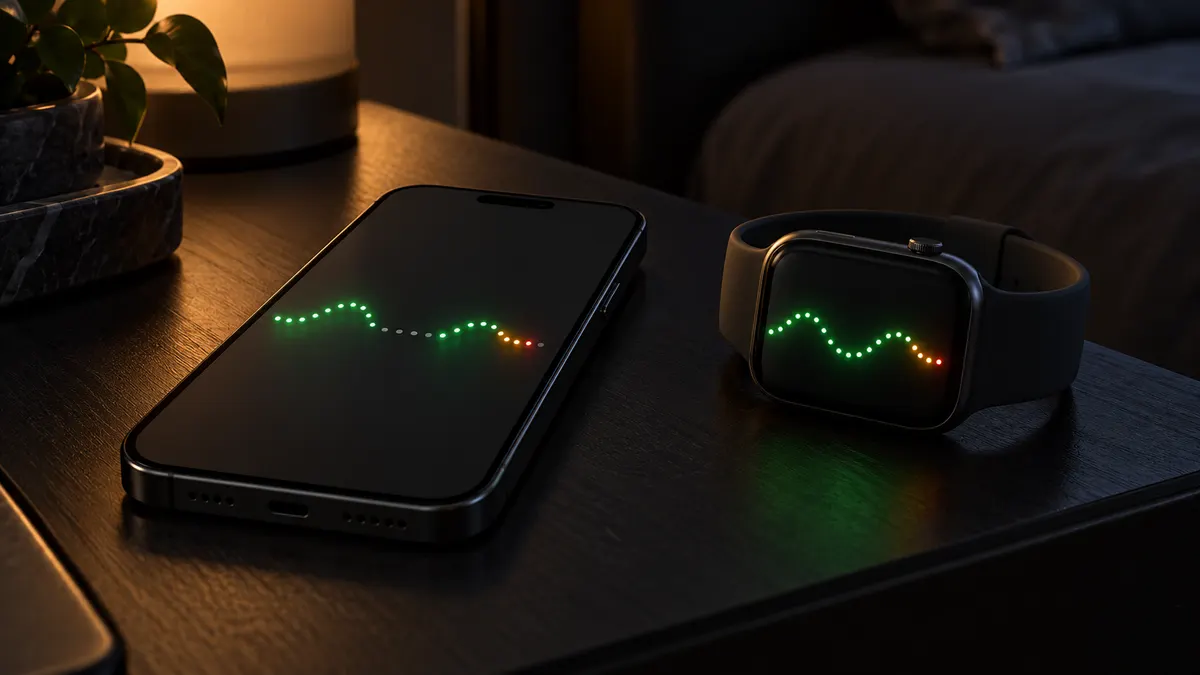
No app can diagnose sleep apnea, so the best sleep apnea app depends on the question you have. If you have never been tested, the closest thing to a screening app is the sleep apnea notification on Apple Watch or a Samsung Galaxy Watch, both authorized by the FDA. A snore recorder lets you hear the snore, silence, gasp pattern and take it to a doctor. If you already use CPAP, your machine's app shows events per hour. Apple's feature caught 66.3% of people with moderate to severe apnea in its validation study.
- Apple Watch sleep apnea notifications: FDA 510(k) K240929, September 2024. In 1,499 people it flagged 66.3% of those with moderate to severe apnea and 1.5% of those without it (FDA summary).
- Samsung's sleep apnea feature: FDA De Novo DEN230041, February 2024, sensitivity 82.7% and specificity 87.7%; it needs a Samsung Galaxy phone and watch (FDA review, Samsung support).
- The American Academy of Sleep Medicine says consumer sleep technology cannot be used to diagnose or treat sleep disorders (AASM position statement, 2018).
- A home sleep apnea test must be ordered by a medical provider (AASM, 2018); Sleep Foundation puts the price at $150 to $1,000.
- We make Snorly, a snore recorder that flags breathing pauses and gasps as worth discussing with a professional. It is not a medical device.
Can an app tell you if you have sleep apnea?
No. Sleep apnea is confirmed by a sleep test that measures airflow, breathing effort and blood oxygen, at home or in a lab. An app can do one of three useful things instead: raise a flag that sends you to that test, give you a recording to play for a doctor, or help you track CPAP therapy after the test.
The AASM's 2018 position statement is blunt: consumer sleep technology cannot be used to diagnose or treat sleep disorders. That has not changed. What has changed is that two watch features now carry FDA authorization as notifications, which puts them in a different class from ordinary sleep apps.
Sleep apnea apps compared
| App or feature | Device | What it measures | FDA status | Best for |
|---|---|---|---|---|
| Apple Watch Sleep Apnea Notifications (Health app) | Apple Watch Series 9 or later, Ultra 2 or later, SE 3, with iPhone | Breathing disturbances from the accelerometer, checked every 30 days | 510(k) K240929, over the counter | iPhone users not yet tested |
| Samsung Health Monitor sleep apnea feature | Galaxy Watch4 or later with a Samsung Galaxy phone | Blood oxygen from the watch sensor over 2 nights within 10 days | De Novo DEN230041 | Samsung users not yet tested |
| Withings Sleep Rx | Under-mattress pad | Sleep and breathing, through a sensor under the mattress | 510(k) K231667, prescription | Through a sleep program, not a store |
| Snorly (ours) | iPhone | Snoring clips, breathing pauses and gasps per hour from the microphone | Not a medical device | Hearing the pattern and taking it to a doctor |
| SnoreLab | iPhone, Android | Snoring, plus an acoustic Breathing Disturbance Index in Premium | Not a medical device | The same, with BreathFlow trends |
| ResMed myAir | ResMed AirSense or AirCurve with wireless | CPAP usage, mask seal, events per hour | Companion to a cleared device | People already on CPAP |
| OSCAR | Mac, Windows, Linux | Detailed CPAP data from the machine's SD card | Free, independent software | CPAP users who want every number |
Oura, Fitbit and Garmin show breathing or oxygen metrics too; they are wellness features, not apnea tools. More on them below.
How accurate is Apple Watch sleep apnea detection?
It is built to catch moderate to severe apnea and to stay quiet otherwise, and the numbers show that trade-off. In the FDA validation study of 1,499 people tested against a home sleep test, the feature flagged 66.3% of people with moderate to severe apnea and gave a false alarm to 1.5% of people without moderate to severe apnea. It caught 89.1% of severe cases but only 43.4% of moderate ones.
So a notification is a strong reason to get tested. No notification is not an all-clear: the FDA summary says so in as many words, and more than half of the moderate cases in the study got none.
How it works: the watch's accelerometer picks up the small movements of breathing and turns each night into a "Breathing Disturbances" value. Every 30 days, if at least half of the nights with a value were elevated, you get a notification. You need to wear the watch to bed at least 10 nights in that 30-day window. The values are in the Health app on iPhone under Respiratory, and you can export a PDF for your doctor. Apple's support page lists Series 9 or later, Ultra 2 or later and SE 3; the feature is for adults 18 and over who have not already been told they have sleep apnea.
Samsung Galaxy Watch sleep apnea feature
Samsung got there first, with an FDA De Novo authorization in February 2024. Its feature reads blood oxygen from the watch's light sensor over two nights within a 10-day window, with about 4 hours of sleep each night. In the FDA review it had a sensitivity of 82.7% and a specificity of 87.7%.
The catch is the ecosystem. It needs a Galaxy Watch4 or later, Samsung Health Monitor from the Galaxy Store, and a Samsung Galaxy phone; Samsung says it is not available on other Android phones or on iPhone. A July 2026 FDA clearance (K261011) extends the feature to the Galaxy Ring and to adults 18 and over; Samsung's own instructions still say 22 and over, so check the app before you rely on it.
What a snore recorder adds
A watch gives you a flag. A recording gives you the sound. Obstructive sleep apnea has a shape you can hear: snoring that gets louder, a silent gap of 10 seconds or more, then a snort or gasp as breathing restarts. One gap means little. The cycle repeating through the night is what a sleep clinician wants to hear about, and a two-minute clip of it is more persuasive in an appointment than "my partner says I stop breathing".
Snorly records only when it hears snoring, saves each clip on a night timeline and counts breathing pauses and gasps per hour, flagged as worth discussing with a professional. It never tells you that you have or do not have apnea. SnoreLab does something similar with an acoustic Breathing Disturbance Index in Premium and labels more than 12 events per hour as elevated; its listing says it is not intended to diagnose or treat sleep apnea.
What a microphone cannot do: measure oxygen, measure breathing effort, or hear a silent pause with no snore around it. Snoring vs sleep apnea shows the pattern on a timeline, and is snoring normal lists the signs that make it worth a visit.
Oura, Fitbit and Garmin: what their breathing numbers mean
All three show something that sounds like apnea tracking. None has FDA authorization for it.
- Oura shows a Breathing Disturbance Index calculated from drops in blood oxygen. Oura's support pages say the ring is not a medical device.
- Fitbit shows Estimated Oxygen Variation, which Google says could indicate breathing disturbances; its blood oxygen readings are for general wellness only.
- Garmin shows Breathing Variations from its Pulse Ox sensor, and its manual says the feature is not a medical device.
Treat a high reading from any of them the way you would treat a partner's comment about your snoring: a reason to look closer, not an answer.
Some App Store listings advertise sleep apnea detection in the headline and say "not a medical device" further down. Both cannot be true in the way the headline implies. Before you trust an apnea claim, search the FDA's 510(k) and De Novo databases for the company name. Apple, Samsung and Withings are in them; most sleep apps are not.
Apps for people already treated for sleep apnea
If you use CPAP, the most useful app is the one that talks to your machine. ResMed's myAir scores each night from usage hours, mask seal, events per hour and how often the mask came off; events per hour is the same number as your AHI on the machine. It works only with ResMed AirSense and AirCurve machines that have wireless built in.
Philips DreamMapper still works with existing Philips machines. A US court consent decree from April 2024 bars Philips Respironics from selling new CPAP and BiPAP machines in the US until it meets the decree's requirements, and Philips said in May 2026 that it would resume sales only then. OSCAR is free desktop software that reads the detailed data on your machine's SD card, breath by breath; its developers never ask for payment. Bring its charts to your sleep doctor rather than changing pressure settings yourself.
How to get tested
Ask a doctor for a sleep test. A home sleep apnea test is a small kit you wear for one or more nights, and it must be ordered by a medical provider. Sleep Foundation puts the cost at $150 to $1,000 for a home test and around $3,000 on average for a night in a lab.
Bring what you have: the watch notification and its PDF, a recording of the snore, silence, gasp cycle, and answers about daytime sleepiness. Those three together get a referral faster than any one of them alone.
- If you have an Apple Watch Series 9 or later, Ultra 2 or later, or SE 3, check that Sleep Apnea Notifications are on in the Health app, and wear the watch to bed.
- Put your phone on the nightstand, 0.5 to 1 m from your head, plugged in, and record the night.
- In the morning, listen for the cycle: snoring, a silent gap, then a gasp.
- If you hear it more than once, or you get a notification, book a doctor visit and bring both.
Hear your own snoring tonightSnorly records only when it hears snoring and plays it back in the morning. Free, no account, no night limit.
Download on the App StoreRelated questions
Is there an app that can detect sleep apnea?
No app can confirm sleep apnea. Apple Watch and Samsung Galaxy Watch have FDA-authorized notifications that flag signs of moderate to severe apnea and send you for a test. Phone apps like Snorly and SnoreLab let you hear and count pauses and gasps to show a doctor.
Can an iPhone detect sleep apnea?
Not on its own. The iPhone has no apnea feature; the FDA-authorized notification runs on Apple Watch and shows its results in the Health app on iPhone. A snore recorder on the iPhone can capture the sound of pauses and gasps.
Is Apple Watch sleep apnea detection accurate?
For severe apnea, fairly: it flagged 89.1% of severe cases in the FDA study, with few false alarms. For moderate apnea it missed more than half. No notification does not mean no apnea.
What is the best app for CPAP users?
The one made for your machine: myAir for ResMed AirSense and AirCurve, DreamMapper for existing Philips machines. OSCAR, free on a computer, shows the most detail from the SD card.
Can a snoring app tell the difference between snoring and sleep apnea?
It can tell steady snoring from the snore, silence, gasp pattern on a recording. It cannot tell whether your oxygen dropped, which is what decides whether those pauses are apnea.
Sources
- U.S. FDA (2024). 510(k) K240929, Sleep Apnea Notification Feature (Apple). https://www.accessdata.fda.gov/cdrh_docs/pdf24/K240929.pdf
- Apple Support (2026). About sleep apnea notifications on Apple Watch. https://support.apple.com/en-us/120031
- U.S. FDA (2024). De Novo DEN230041, Samsung Sleep Apnea Feature, decision summary. https://www.accessdata.fda.gov/cdrh_docs/reviews/DEN230041.pdf
- U.S. FDA (2026). 510(k) K261011, Samsung Sleep Apnea Feature v2.0. https://www.accessdata.fda.gov/cdrh_docs/pdf26/K261011.pdf
- Samsung (accessed 2026). Sleep apnea feature support page. https://www.samsung.com/us/support/answer/ANS10003433/
- U.S. FDA (2024). 510(k) K231667, Withings Sleep Rx. https://www.accessdata.fda.gov/cdrh_docs/pdf23/K231667.pdf
- Khosla S, Deak MC, Gault D, et al. (2018). Consumer Sleep Technology: An American Academy of Sleep Medicine Position Statement. Journal of Clinical Sleep Medicine. https://pubmed.ncbi.nlm.nih.gov/29734997/
- Rosen IM, Kirsch DB, Carden KA, et al. (2018). Clinical Use of a Home Sleep Apnea Test: An Updated American Academy of Sleep Medicine Position Statement. Journal of Clinical Sleep Medicine. https://pubmed.ncbi.nlm.nih.gov/30518456/
- U.S. FDA (2024). Federal court enters consent decree against Philips Respironics. https://www.fda.gov/news-events/press-announcements/federal-court-enters-consent-decree-against-philips-respironics-following-recall-certain-sleep
- Philips (2026). Philips Respironics FAQ, 6 May 2026. https://www.philips.com/c-dam/assets/corporate/global/investor/20260506_Respironics_FAQ.pdf
- Oura (accessed 2026). Oura support: Oura Ring is not a medical device. https://support.ouraring.com/hc/en-us/articles/7328398760851
- Google Fitbit Help (accessed 2026). Estimated Oxygen Variation. https://support.google.com/fitbit/answer/14237927
- Garmin (accessed 2026). Breathing Variations, owner's manual. https://www8.garmin.com/manuals/webhelp/GUID-C001C335-A8EC-4A41-AB0E-BAC434259F92/EN-US/GUID-636632DF-E3E8-4C15-936A-CFB7EA2B5C39.html
- ResMed (accessed 2026). Understanding your myAir score. https://www.resmed.com/en-us/sleep-health/blog/myair-tips-understanding-your-myair-score/
- SnoreLab (accessed 2026). BreathFlow and the Breathing Disturbance Index. https://www.snorelab.com/breathing
- Sleep Foundation (2026). How Much Does a Sleep Study Cost? https://www.sleepfoundation.org/sleep-studies/how-much-does-a-sleep-study-cost
Snorly is a snore recorder and tracker, not a medical device. It does not diagnose sleep apnea or any other condition. If you notice pauses in breathing, gasping or daytime sleepiness, talk to a doctor.