Body pillow for snoring: does it keep you off your back?

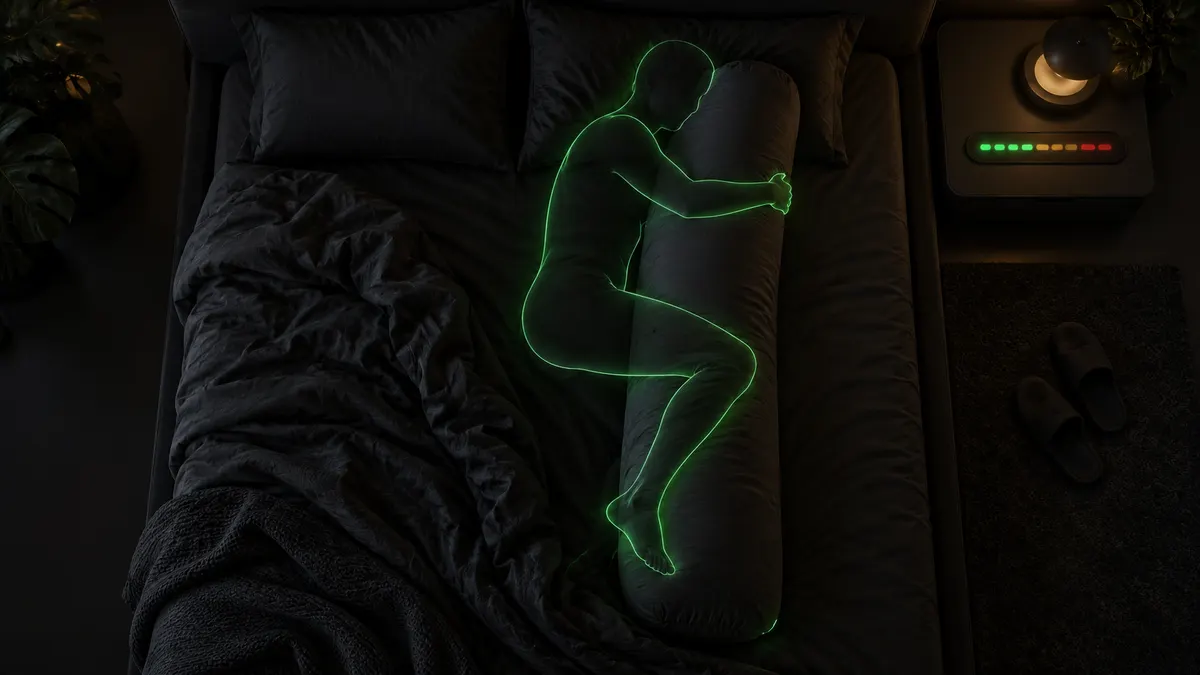
A body pillow helps snoring in one case: you snore mostly on your back, and the pillow keeps you on your side. It does nothing to the airway itself. Position matters for a large group: in the biggest sleep-lab series on the question, 55.9% of 574 patients had at least twice as many breathing events on their back as on their side (Oksenberg et al. 1997). No published trial has tested a body pillow alone, so seven recorded nights are the test that counts.
- 55.9% of 574 sleep-apnea patients breathed at least twice as badly on their back as on their side (Oksenberg et al. 1997).
- In 72 habitual snorers, most of those without apnea snored for less time and more quietly on their side (Nakano et al. 2003).
- The NHS advice for snorers is to buy a special pillow or bed wedge to help keep you on your side (NHS, Snoring).
- A 2019 Cochrane review counts full-length pillows among positional devices; across 8 trials, positional therapy cut breathing events by 7.4 an hour more than an inactive control (Srijithesh et al. 2019). We found no trial of a body pillow on its own (PubMed, October 2026).
- We have no Snorly data on body pillows yet. When enough users have tagged pillow nights, we will add what those nights show.
This article is about the long pillow you hug or wedge behind you. Wedges, memory foam and head-turning pillows are covered in do anti-snoring pillows work, and the case for side sleeping in general is in which sleeping position stops snoring.
Does a body pillow help with snoring?
Yes, if two things are true: your snoring is positional, and the pillow actually stops you rolling onto your back. If you snore just as loudly on your side, a body pillow changes nothing you can hear.
On your back, gravity pulls the tongue and soft palate toward the back of the throat and the airway narrows. On your side, the tongue falls sideways and the gap stays wider. Nakano's team compared back and side sleep on the same night in 72 habitual snorers: in those without apnea, both snoring time and loudness dropped on the side. In people with apnea the result was mixed, because a narrow airway stays narrow in every position. Position matters most in milder cases: in one sleep-lab series, 49.5% of mild apnea was positional against 6.5% of severe (Mador et al. 2005).
Is your snoring positional? Check before you buy
Record two or three nights first. A positional snorer has a recognisable timeline: quiet for the first hours, while you are still on the side you fell asleep on, then loud from the moment you rolled onto your back, often after 2 or 3 a.m.
A night that is loud from the first hour points away from position and toward the nose, an open mouth or a late drink. Why do I snore walks through those causes one by one. A phone recording cannot see which way you are lying, so write down the position you woke up in each morning and put it next to the night's timeline.
Which body pillow shape works for snoring?
The shape that blocks the roll onto your back. Body pillows come in three main shapes, straight, U and C, mostly 48 to 54 inches long (Sleep Foundation), plus J-shaped pregnancy versions. A pillow you only hug in front of you keeps your top arm and knee comfortable but leaves your back open, and the roll that makes you snore is the one onto your back.
| Shape | What blocks the roll | Good for | Weak point |
|---|---|---|---|
| Straight (rectangular), typically 20 × 54 in | Behind your back, the roll; hugged in front, only your front | The cheapest; fits a full or queen bed with a partner | Easy to push away in your sleep |
| U-shape | A wall on both sides of your body | The most reliable blocker; popular in pregnancy | Takes half a queen bed, warm |
| C-shape | Wraps your head, front and knees, back is partly open | Side sleepers with neck or hip pain | Blocks less than a U |
| J-shape | Head and front | Smaller beds | Back is open |
| Two straight pillows | One hugged in front, one wedged behind | Testing the idea before buying a U | Two pillows to keep in place |
Firmness matters more than fill. A soft pillow flattens under your weight and you roll over it by morning. Look for one that springs back when you press it down by hand.
Where should the body pillow go, front or back?
For snoring, behind you. Push a firm straight pillow lengthwise against your back, tight enough that rolling over means climbing onto it. Hug a second pillow, or the other arm of a U, in front, with your top knee resting on it. That keeps your hips stacked, takes the twist out of your lower back, and removes the main reason people turn over at night.
Keep your head pillow high enough that your neck stays level with your spine. A head pillow that is too flat on your side tilts your chin down and can narrow the airway you were trying to open.
Body pillow vs tennis ball vs vibrating trainer
All three do the same job: keep you off your back. They differ in how firmly they do it and how long people keep using them.
| Method | How it keeps you on your side | Evidence | Weak point |
|---|---|---|---|
| Body pillow behind you | A soft wall you would have to climb over | No trial of its own; listed among positional devices by Cochrane (2019) | Easy to push away |
| Tennis ball in a T-shirt | Makes the back position uncomfortable | Works while worn; 4 of 67 still using it after 2.5 years, most quit over comfort (Bignold 2009) | Comfort |
| Vibrating position trainer | Buzzes until you turn | Back sleeping cut from 49.9% of the night to 0% and breathing events from 16.4 to 5.2 per hour in one month (van Maanen 2013) | A chest strap and a price |
The body pillow is the gentlest of the three and the easiest to push away. If your recordings show you still rolling onto your back with it, the next step is the ball or the trainer, not a more expensive pillow.
How to test a body pillow in 7 nights
Record every night with the phone in the same place, 0.5 to 1 m from your head, and change only the pillow. Three baseline nights give you a range; four pillow nights show whether the range moved.
| Night | Setup | Note in the morning |
|---|---|---|
| 1 to 3 | Your usual bed, no body pillow | Position you woke up in |
| 4 to 7 | Body pillow behind you, a second one or a U in front | Position you woke up in, and whether the pillow was still behind you |
In Snorly, tag nights 4 to 7 with the pillow as a remedy; the app puts tagged and untagged nights side by side and the timeline shows the hour the snoring started. Rule for calling it: if every pillow night has fewer snore minutes than your quietest baseline night, keep the pillow. If the loud part of the night just starts later, you are still rolling over and the pillow needs to be firmer or bigger. If the ranges overlap, position is probably not your cause.
Do pregnancy pillows help with snoring?
They can, for the same reason, and pregnancy is when snoring often starts. In a cohort of 1,673 women, 35% snored habitually in the third trimester, and 26% had started during the pregnancy (O'Brien et al. 2013). Going to sleep on your side, either side, is the position the research supports in late pregnancy (Cronin et al. 2019), so a U- or C-shaped pregnancy pillow does two jobs at once. Loud snoring with pauses or gasps in pregnancy is worth raising at the next prenatal visit rather than solving with a pillow. Snoring in women covers the hormonal side.
- Put the phone on the nightstand, plugged in, and record a night without the body pillow. Baseline 1 of 3.
- Note in the morning which position you woke up in.
- Skip alcohol for the test week; it relaxes the airway in every position and would blur the result.
- No body pillow yet? Roll a duvet lengthwise and push it against your back for nights 4 to 7 before you buy one.
Hear your own snoring tonightSnorly records only when it hears snoring and plays it back in the morning. Free, no account, no night limit.
Download on the App StoreRelated questions
Do body pillows help you stop snoring?
Only if you snore on your back and the pillow keeps you off it. Over half of the patients in the largest sleep-lab series breathed at least twice as badly on their back. If you snore just as much on your side, a body pillow will not change your recording.
Should a body pillow go in front or behind you?
Behind you, if snoring is the reason. A pillow pushed against your back is what blocks the roll onto your back. A second pillow in front for your arm and top knee keeps you comfortable enough to stay put.
What is the best pillow to keep you on your side?
A firm U-shaped body pillow blocks the roll on both sides. Two firm straight pillows, one behind and one in front, do the same job for less money. Soft pillows flatten and you roll over them by morning.
Can a pillow fix sleep apnea?
No. Side sleeping can reduce breathing events in mild positional apnea, but it is not a treatment for moderate or severe apnea. Snoring with pauses and gasps on your recording is a reason to see a doctor and get a sleep test. Read snoring vs sleep apnea for the pattern.
Sources
- Oksenberg A, Silverberg DS, Arons E, Radwan H (1997). Positional vs Nonpositional Obstructive Sleep Apnea Patients. Chest 112(3):629-639. https://doi.org/10.1378/chest.112.3.629
- Nakano H, Ikeda T, Hayashi M, Ohshima E, Onizuka A (2003). Effects of body position on snoring in apneic and nonapneic snorers. Sleep 26(2):169-172. https://doi.org/10.1093/sleep/26.2.169
- Bignold JJ, Deans-Costi G, Goldsworthy MR, et al. (2009). Poor long-term patient compliance with the tennis ball technique for treating positional obstructive sleep apnea. Journal of Clinical Sleep Medicine 5(5):428-430. https://pmc.ncbi.nlm.nih.gov/articles/PMC2762713/
- van Maanen JP, Meester KA, Dun LN, et al. (2013). The sleep position trainer: a new treatment for positional obstructive sleep apnoea. Sleep and Breathing 17(2):771-779. https://doi.org/10.1007/s11325-012-0764-5
- Mador MJ, Kufel TJ, Magalang UJ, et al. (2005). Prevalence of positional sleep apnea in patients undergoing polysomnography. Chest 128(4):2130-2137. https://pubmed.ncbi.nlm.nih.gov/16236865/
- Srijithesh PR, Aghoram R, Goel A, et al. (2019). Positional therapy for obstructive sleep apnoea. Cochrane Database of Systematic Reviews, CD010990. https://pubmed.ncbi.nlm.nih.gov/31041813/
- O'Brien LM, Bullough AS, Owusu JT, et al. (2013). Snoring during pregnancy and delivery outcomes: a cohort study. Sleep 36(11):1625-1632. https://pmc.ncbi.nlm.nih.gov/articles/PMC3792378/
- Cronin RS, Li M, Thompson JMD, et al. (2019). An individual participant data meta-analysis of maternal going-to-sleep position, interactions with fetal vulnerability, and the risk of late stillbirth. EClinicalMedicine 10:49-57. https://pubmed.ncbi.nlm.nih.gov/31193832/
- NHS (accessed 2026). Snoring. https://www.nhs.uk/symptoms/snoring/
- Sleep Foundation (accessed 2026). Best Body Pillows. https://www.sleepfoundation.org/best-pillows/best-body-pillow
Snorly is a snore recorder and tracker, not a medical device. It does not diagnose sleep apnea or any other condition. If you notice pauses in breathing, gasping or daytime sleepiness, talk to a doctor.