Sleep Talking App: Record What You Say in Your Sleep

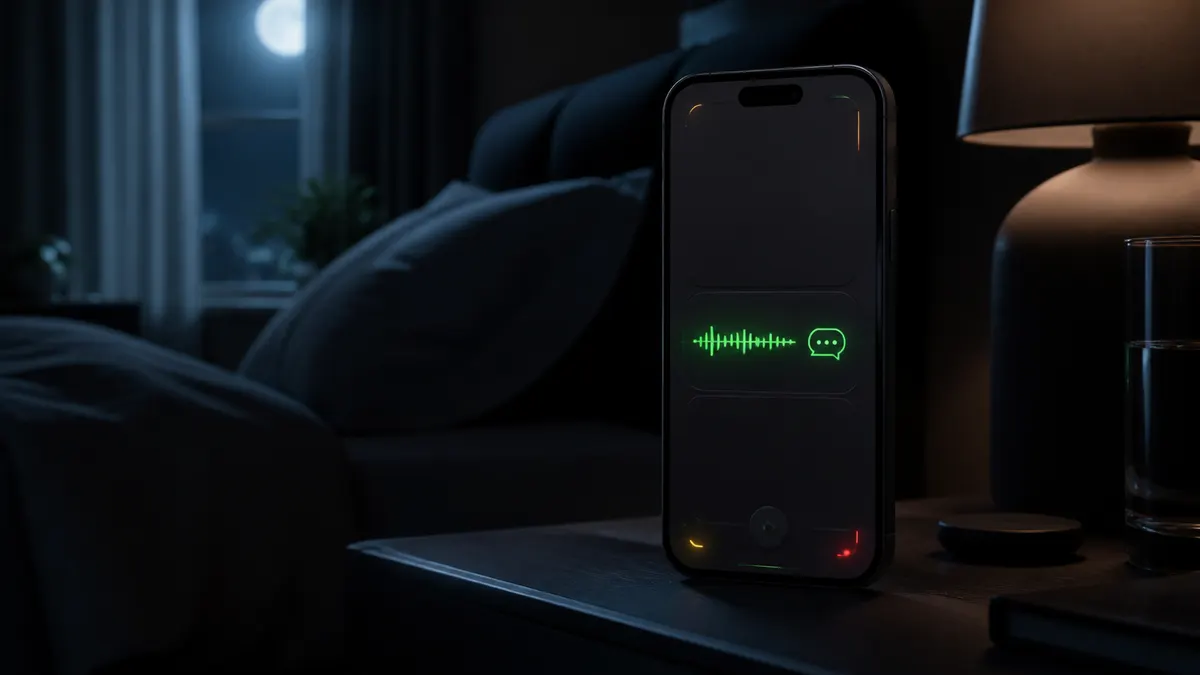
A sleep talking app is any recorder that listens all night and keeps only the seconds with sound, so you wake up to a list of time-stamped clips instead of an 8-hour file to scrub. The setup is the same as recording snoring: iPhone on the nightstand, 0.5 to 1 m from your head, plugged in, Do Not Disturb on. About two in three adults have talked in their sleep at some point, so expect to find something within a few nights.
- About two in three adults have talked in their sleep at least once, and roughly one in six do it currently (Bjorvatn 2010, survey of about 1,000 Norwegian adults)
- In a sleep-lab study of 232 people, most recorded "speech" was mumbling, whispering or laughing, and the single most common word was "no" (Arnulf 2017)
- Sleep talk is usually quieter than snoring: a whisper is about 30 dB, normal speech about 60 dB, loud snoring 50 to 90 dB (CDC noise scale)
- An 8-hour Voice Memo at the default setting is roughly 200 to 250 MB; a sound-triggered app keeps a few dozen short clips (user measurements; our data)
- Sleep talking on its own is harmless and needs no treatment; frequent shouting with thrashing is a different pattern worth a doctor visit (AASM Sleep Education)
What app records sleep talking?
Any recorder that starts a clip when it hears sound and stops when the room goes quiet will catch sleep talking. The differences are in whether the app labels talking separately from snoring, whether you can play the clips back for free, and whether the audio leaves your phone.
| App | What it keeps | Labels talking? | Platform |
|---|---|---|---|
| Snorly | Clips only, tagged Snore, Sleep talk or Cough, on a night timeline | Yes | iPhone |
| Sleep Talk Recorder | Sound-activated clips, the original app in this niche (App Store rating 4.3, about 2,700 ratings, September 2026) | No, every sound is a clip | iPhone |
| Dream Talk Recorder | Sound-activated clips, similar idea (4.7, about 2,700 ratings) | No | iPhone |
| Sleep Cycle | Sleep tracker with a Sleep Talk feature; playback is in Premium | Yes | iPhone, Android |
| SnoreLab | Snoring samples; talking shows up when it is loud enough to trigger a sample | No | iPhone, Android |
| Voice Memos | One continuous file for the whole night | No | iPhone |
Snorly is our app, so weigh that row accordingly. It records only when it hears something, runs the classification on the phone, and marks each clip as snoring, sleep talk or cough, so a night with both shows two kinds of bars on one timeline. Recording, playback and history are free with no night limit; Premium only adds full-night audio, remedy comparisons and the PDF report.
How do I record myself sleep talking?
Set the phone up exactly as you would for recording snoring: nightstand, screen down, 0.5 to 1 m from your head, plugged in, Do Not Disturb on. Then make two changes because talking is quieter and rarer than snoring.
- Move the phone to the near side of the bed. Snoring at 60 dB carries across a room; a mumble at 30 dB does not.
- Turn any fan or air purifier away from the phone, or turn it off. Steady noise raises the threshold a sound-triggered app needs to start a clip.
With Voice Memos you get the whole night as one file and have to scrub for a few seconds of speech. With a sound-triggered app you get the timestamps. Either way, record three nights before deciding you do not talk: sleep talking comes in phases, and one silent night proves nothing.
Why do I talk in my sleep?
Speech can leak out in any sleep stage. Deep-sleep episodes tend to be mumbles and single words; REM episodes, when dreams are most vivid, are more likely to be sentences. Known amplifiers are stress, short sleep, fever, alcohol in the evening and a family history of sleep talking or sleepwalking. It also clusters in time: weeks of nightly commentary, then months of nothing.
None of that is a disorder. Sleep medicine files sleep talking (somniloquy) as a parasomnia that usually needs no treatment. Children do it most; adults do it less with age but rarely stop entirely.
What do sleep talking recordings actually contain?
Mostly mumbles. In the largest recorded study, researchers analysed hundreds of speech episodes from 232 adults in a sleep lab. More than half were non-verbal: whispers, laughs, mumbles. Among real words, "no" was the most frequent, a lot of the content was negative or argumentative, and swearing was common. The sentences that did occur were grammatical and paced like normal speech, which is why they sound so convincing in the morning.
What they are not is testimony. Sleep speech is loosely tied to dream content and not at all to waking intentions. If a clip sounds like an argument, that is the most ordinary result in the dataset, not a confession.
Is sleep talking dangerous?
By itself, no. Two patterns on a recording are worth acting on, and neither is the talking.
- Shouting, swearing or crying out most nights, with movement you can hear (kicking, hitting the headboard), especially after age 50. That can be REM sleep behavior disorder, where the body acts out dreams, and it is a reason to see a sleep doctor.
- Talking that sits between snoring, a silent gap and a loud gasp. That pattern is about breathing, not speech. Read snoring vs sleep apnea for what it looks like on a timeline.
If you record a scream once a year after a hard week, that is a night terror or a nightmare and needs nothing.
What if the recording shows snoring instead?
This is the most common surprise. People go looking for the 3 a.m. commentary a partner mentioned and find that most of the clips are snoring. Treat that as the useful result: talking is a quirk, snoring is measurable and often fixable. Start with what snoring sounds like in decibels to read the loudness labels, then why do I snore to find the cause.
How do I stop sleep talking?
There is no proven treatment for ordinary sleep talking, and most people do not need one. What reduces it is the same list that reduces every parasomnia: sleep long enough on a regular schedule, cut evening alcohol, and take stress down before bed rather than in bed. If a partner is losing sleep over it, earplugs rated NRR 30 or more and white noise handle a mumble easily; the partner snoring guide covers both.
Recording helps here too. A week of clips shows whether the talking is nightly or once a month, whether it follows late nights or drinks, and whether it comes with snoring. That is usually enough to stop worrying about it.
- Put the phone on the nightstand on your side of the bed, screen down, plugged in, Do Not Disturb on.
- Turn the fan away from the phone or switch it off.
- Start a sound-triggered recorder, or a Voice Memo if that is what you have.
- In the morning, listen to the clips once and note two things: how many were talking, and how many were snoring.
- Repeat for three nights before drawing any conclusion.
Hear your own snoring tonightSnorly records only when it hears snoring and plays it back in the morning. Free, no account, no night limit.
Download on the App StoreRelated questions
Can an iPhone record sleep talking?
Yes. Voice Memos records the whole night as one file (roughly 200 to 250 MB for 8 hours at the default setting). A sound-triggered app keeps only the clips with sound, which is far easier to review. Keep the phone plugged in either way.
Does Snorly record sleep talking?
Yes. Snorly records only when it hears sound and tags each clip as snoring, sleep talk or cough, all processed on the phone. Talk clips appear on the same timeline as snoring, so you can see whether they cluster before or after a snoring run.
Why does my sleep talking sound angry?
Because most recorded sleep speech is. In the largest lab study, "no" was the most common word and a large share of episodes were negative or argumentative. It reflects how the sleeping brain generates speech, not what you think of the person next to you.
Does sleep talking mean I have a sleep disorder?
On its own, no. Sleep talking is classed as a parasomnia that usually needs no treatment. Nightly shouting with movement, or talking mixed with silent gaps and gasps, are the two patterns worth taking to a doctor.
How do I know if I talk in my sleep if I live alone?
Record three nights with a sound-triggered app. One silent night does not settle it, because sleep talking comes in phases. The same recording will also tell you whether you snore.
Sources
- Bjorvatn B, Grønli J, Pallesen S (2010). Prevalence of different parasomnias in the general population. Sleep Medicine. https://doi.org/10.1016/j.sleep.2010.07.011
- Arnulf I, Uguccioni G, Gay F, et al. (2017). What Does the Sleeping Brain Say? Syntax and Semantics of Sleep Talking in Healthy Subjects and in Parasomnia Patients. Sleep. https://doi.org/10.1093/sleep/zsx159
- American Academy of Sleep Medicine, Sleep Education (accessed 2026). Sleep Talking. https://sleepeducation.org/sleep-disorders/sleep-talking/
- Sleep Foundation (2026). Sleep Talking: What Is Somniloquy? https://www.sleepfoundation.org/parasomnias/sleep-talking
- CDC (accessed 2026). What Noises Cause Hearing Loss? https://www.cdc.gov/nceh/hearing_loss/what_noises_cause_hearing_loss.html
Snorly is a snore recorder and tracker, not a medical device. It does not diagnose sleep apnea or any other condition. If you notice pauses in breathing, gasping or daytime sleepiness, talk to a doctor.