Do anti-snoring pillows work? Tested by recording

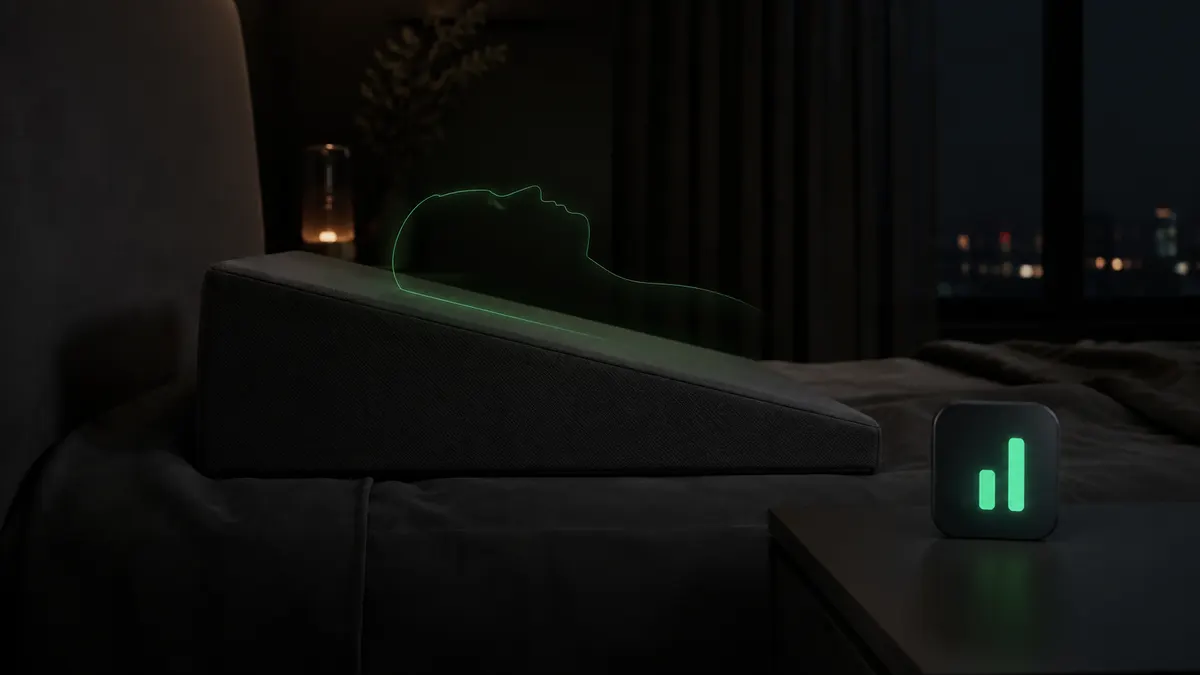
Anti-snoring pillows work when they change one of two things: the angle of your head or the side you sleep on. In the sleep-lab studies that measured snoring rather than asking about it, a memory foam pillow cut snoring events by 47% in three-hour sessions (Stavrou et al. 2022), an inclined side-sleeping pillow cut breathing events from 17 to under 5 per hour in mild to moderate apnea (Zuberi et al. 2004), and a pillow that turns the head reduced the snoring index in a four-week crossover trial (Cazan et al. 2017). None of that tells you whether your pillow works. Seven recorded nights do.
- In a randomized single-centre trial, 12 patients on a memory foam pillow went from 106 to 56 snoring events per 3-hour session, a 47% drop, and snoring time fell from 42.2 to 37.5 minutes; their own pillow produced no significant change (Stavrou et al. 2022).
- In 22 patients with sleep apnea, an inclined triangular pillow for side sleeping lowered the respiratory disturbance index from an average of 17 to fewer than 5 events per hour, and snoring decreased or disappeared (Zuberi et al. 2004).
- In a randomized crossover of 22 snorers without apnea, 4 weeks at home plus two lab nights, a head-turning pillow significantly reduced the snoring index with no worsening of breathing (Cazan et al. 2017).
- 55.9% of 574 sleep-apnea patients had at least twice as many breathing events on their back as on their side, and the effect was strongest in younger, thinner, milder cases (Oksenberg et al. 1997).
- Pillows sold as snore-stoppers with no stated mechanism have no controlled evidence (Mayo Clinic).
This article is part of a series on cheap remedies you can check with a recorder instead of a review: mouth tape, nasal strips and the anti-snoring pillow. The numbers here are from published sleep-lab trials. When enough Snorly users have tagged pillow nights, we will add what those nights show.
What the studies measured
The memory foam result is the cleanest before-and-after. Stavrou's group put patients through three-hour daytime sleep sessions on different pillows and counted snoring events from the polysomnograph. The memory foam pillow roughly halved the count; the patients' own pillows did not.
| Snoring events | Own pillow | Memory foam | Change |
|---|---|---|---|
| Snoring events | 106 | 55.8 | -47% |
The inclined pillow trial measured breathing events rather than snores, in people who had sleep apnea to begin with. The number that matters for snorers is the direction: a pillow that keeps you on your side moved a clinical index the way a medical device is expected to.
| Events per hour (RDI) | Usual pillow | Inclined pillow | Change |
|---|---|---|---|
| Respiratory disturbance index | 17 | 5 | -71% |
Cazan's trial is the only one that ran for weeks at home, which is how you will use a pillow. The paper reports the snoring index as significantly reduced without giving the raw numbers, so it is not charted here.
Which kind of pillow does what
| Pillow type | What it changes | Evidence | Best for |
|---|---|---|---|
| Wedge or inclined | Raises the head and chest, gravity pulls the tongue forward less | Zuberi 2004 (22 patients): RDI 17 to under 5 | Back sleepers who cannot switch sides, reflux |
| Side-sleeping or body pillow | Keeps you off your back | Oksenberg 1997: half of patients breathe twice as badly on their back | Positional snorers, most plain snorers |
| Contoured memory foam | Holds the neck so the chin does not drop to the chest | Stavrou 2022 (12 patients): snoring events down 47% | Back and side sleepers with a soft, flat pillow |
| Head-turning or "smart" | Detects snoring and tilts the head | Cazan 2017 (22 snorers): snoring index reduced, p = 0.03 | People who will not stay on their side |
| "Anti-snore" with no stated mechanism | Nothing measurable | None | Nobody; test it anyway if you own one |
The common thread is position and neck angle. A pillow that does not change either is a pillow.
Does a wedge pillow help with snoring?
A wedge pillow helps back sleepers who cannot stay on their side, and it works by raising the whole torso, not only the head. A wedge is a firm foam triangle, usually 7 to 12 inches (18 to 30 cm) high at the thick end (Sleep Foundation); on a wedge about 24 inches long that is a slope of roughly 15 to 30 degrees. It goes under the back from the hips up.
Flat on your back, gravity pulls the tongue and soft palate into the throat; on an incline part of that pull shifts toward the chest. Lying flat also swells the lining of the nose, which is why congestion feels worse in bed.
Zuberi's inclined pillow, charted above, took breathing events from 17 to under 5 per hour. In a sleep-lab study of 52 people with sleep apnea, tilting the whole bed by 7.5 degrees, a gentler slope than any wedge, cut the median apnea-hypopnea index from 15.7 to 10.7 events per hour; the seven patients who slept flat again on a third night went back to baseline (Souza et al. 2017). Neither study counted snores directly, so treat this as a reason to test, not a promise.
Who it suits: back sleepers who roll off a side pillow, reflux at night, late pregnancy, a blocked nose. Who it does not: side sleepers, who slide down the slope by morning, and anyone who props only the head, which bends the neck forward and narrows the throat. Neck pain means the wedge is too steep or too short.
Test it like any other pillow: three baseline nights, four wedge nights, the seven-night plan below.
How to test your pillow in 7 nights
Record every night with the phone in the same place, 0.5 to 1 m from your head, and change only the pillow. Three baseline nights give you a range; four nights on the new pillow show whether the range moved.
| Night | Pillow | Rules |
|---|---|---|
| 1 to 3 | Your usual one | Same bedtime within 30 minutes, no alcohol, record all night |
| 4 to 7 | The new one | Same rules; note the position you woke up in |
Compare snore minutes, clip count and the loudest clip's label. In Snorly, tag nights 4 to 7 with the pillow as a remedy and the app puts tagged and untagged nights side by side. The position note matters: a side-sleeping pillow that you roll off at 3 a.m. will show up as a night that started quiet and got loud, which the timeline makes obvious.
Rule for calling it: if every pillow night has fewer snore minutes than your quietest baseline night, keep it. If the ranges overlap, the pillow is not your fix.
Is it the pillow or the position?
Usually the position. In Oksenberg's series more than half the patients had at least double the breathing events on their back. If your recordings show a quiet first half of the night and a loud second half, you probably started on your side and rolled over. A cheaper experiment than any pillow: a tennis ball in a sock pinned to the back of a T-shirt for the four test nights. If that fixes it, any pillow that keeps you on your side will, and you can pick by comfort. The full ranking of fixes is in how to stop snoring.
- Put the phone on the nightstand, plugged in, and record on your usual pillow. Baseline 1 of 3.
- Note the position you fell asleep in and the one you woke up in.
- Skip alcohol; it relaxes the airway and would hide a pillow effect.
- Do not buy anything yet. Three baseline nights first, then the pillow, then the comparison.
Hear your own snoring tonightSnorly records only when it hears snoring and plays it back in the morning. Free, no account, no night limit.
Download on the App StoreRelated questions
Do anti-snoring pillows really work?
The ones that change head angle or keep you on your side have sleep-lab evidence: snoring events down 47% with memory foam in one trial, breathing events from 17 to under 5 per hour with an inclined pillow in another. Pillows that change neither have none.
What is the best pillow for snoring?
The one that keeps you off your back or holds your neck so your chin does not drop, and that you will actually sleep on for a month. The studies used a contoured memory foam pillow, a triangular inclined pillow and a head-turning pillow; comfort decides between them.
Does sleeping with your head elevated stop snoring?
It reduces it for many back sleepers. Raising the head and upper body lowers the pull of gravity on the tongue and soft palate. The inclined-pillow trial saw breathing events fall from 17 to under 5 per hour, though those patients also slept on their side.
Can a pillow help with sleep apnea?
It can reduce mild positional apnea, as in the Zuberi trial, but it is not a treatment for moderate or severe apnea and no app can diagnose it. Snoring with pauses and gasps on your recording is a reason for a sleep test, not a new pillow.
Sources
- Stavrou VT, Boutou AK, Vavougios GD, et al. (2022). Memory Foam Pillow as an Intervention in Obstructive Sleep Apnea Syndrome: A Preliminary Randomized Study. Frontiers in Medicine. https://pmc.ncbi.nlm.nih.gov/articles/PMC8967243/
- Zuberi NA, Rekab K, Nguyen HV (2004). Sleep apnea avoidance pillow effects on obstructive sleep apnea syndrome and snoring. Sleep and Breathing 8(4):201-207. https://doi.org/10.1007/s11325-004-0201-5
- Souza FJFB, Genta PR, de Souza Filho AJ, Wellman A, Lorenzi-Filho G (2017). The influence of head-of-bed elevation in patients with obstructive sleep apnea. Sleep and Breathing 21(4):815-820. https://doi.org/10.1007/s11325-017-1524-3
- Cazan D, Mehrmann U, Wenzel A, Maurer JT (2017). The effect on snoring of using a pillow to change the head position. Sleep and Breathing 21(3):615-621. https://doi.org/10.1007/s11325-017-1461-1
- Oksenberg A, Silverberg DS, Arons E, Radwan H (1997). Positional vs Nonpositional Obstructive Sleep Apnea Patients. Chest. https://doi.org/10.1378/chest.112.3.629
- Mayo Clinic. Snoring: Diagnosis and treatment. https://www.mayoclinic.org/diseases-conditions/snoring/diagnosis-treatment/drc-20377701
- Sleep Foundation (accessed 2026). Best Wedge Pillows. https://www.sleepfoundation.org/best-pillows/best-wedge-pillow
Snorly is a snore recorder and tracker, not a medical device. It does not diagnose sleep apnea or any other condition. If you notice pauses in breathing, gasping or daytime sleepiness, talk to a doctor.