Do nasal strips work for snoring? What recordings show

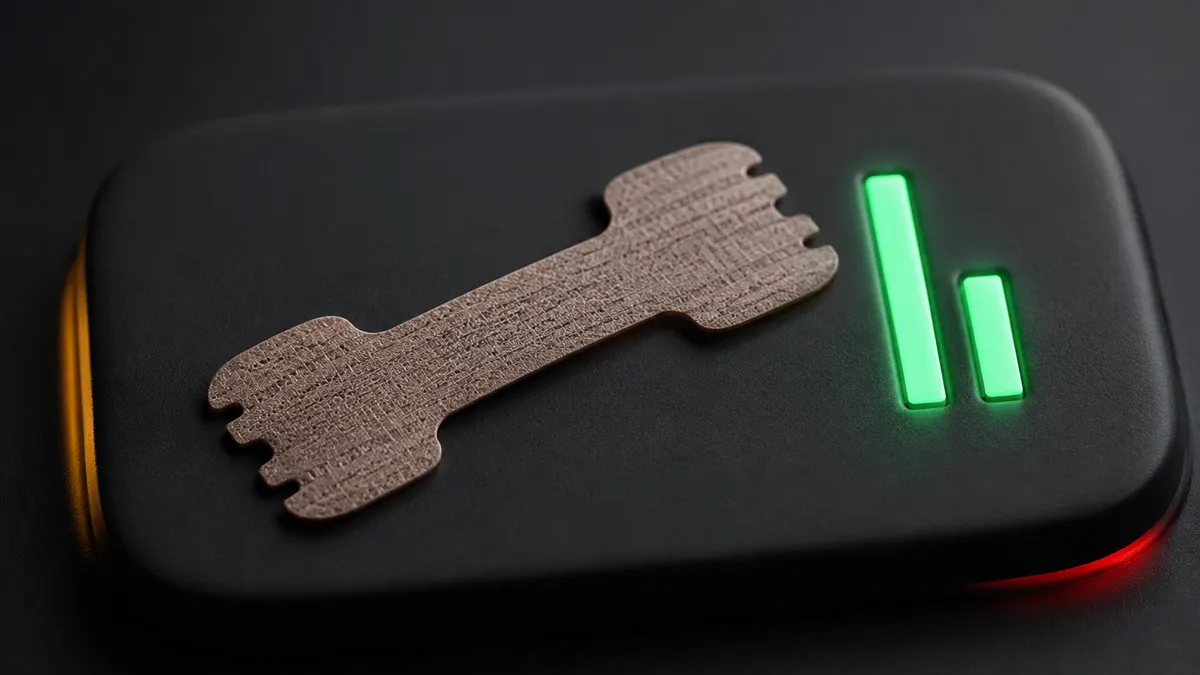
Nasal strips reduce snoring for one kind of snorer: the person whose nose is narrow or congested at night. In the only placebo-controlled sleep-lab trial, 12 people with chronic rhinitis went from 258 snores an hour on a placebo strip to 173 on a real one, a third fewer, while the loudness of each snore did not change (Pevernagie et al. 2000). Pooled across every study, the effect is small and not statistically certain. Whether it works for you is a seven-night question, and a phone can answer it.
- In a randomized placebo-controlled trial of 12 chronic rhinitis patients, Breathe Right strips lowered snoring frequency from 258 to 173 snores per hour; snoring loudness, arousals and the apnea-hypopnea index did not change (Pevernagie et al. 2000).
- Pooled over five polysomnography studies with 111 patients, the snoring index went from 148 to 96 snores per hour with nasal dilators, a difference that did not reach statistical significance (Camacho et al. 2016).
- In 30 habitual snorers measured in a sleep lab, a strip reduced maximum snoring intensity in 22 of the 30, mostly during light sleep (Todorova et al. 1998).
- In 35 heavy snorers without apnea, bed partners rated snoring significantly quieter after 14 nights of strips, and the snorers reported less mouth dryness (Ulfberg and Fenton 1997).
- Nasal dilators did not change the apnea-hypopnea index across 10 studies, 28.7 to 27.4 events per hour (Camacho et al. 2016); they are not a treatment for sleep apnea.
This article is part of a series on cheap remedies that you can check with a recorder instead of a review: mouth tape, nasal strips and the anti-snoring pillow. The numbers below come from published sleep-lab studies. As Snorly users tag strip nights in the app, we will add what those nights show.
What the studies measured
The clearest number is from Ghent, Belgium. Twelve non-obese adults with chronic rhinitis, all snorers with no sleep apnea, slept in the lab three times: a baseline night, a night with a placebo strip and a night with a real Breathe Right strip, in random order. Snores per hour fell by about a third with the real strip. Everything else, including how loud each snore was, stayed where it was.
| Snores per hour | Placebo strip | Real strip | Change |
|---|---|---|---|
| Snoring frequency | 258 | 173 | -33% |
The meta-analysis is the sobering counterpart. When Camacho and colleagues pooled every sleep-lab study of external strips and internal dilators, snoring dropped on average, but the spread between people was so wide that the pooled result could have been chance.
| Snores per hour | No dilator | With dilator | Change |
|---|---|---|---|
| Pooled snoring index | 148.2 | 96.3 | -35% |
Read the two charts together: a strip helps a lot in people whose nose is the problem and does nothing in people whose nose is not, and the average hides both.
Do nasal strips help with snoring, or only with breathing?
They help snoring only when nasal resistance is what is making you snore. A strip pulls the sides of the nose outward and widens the nasal valve, the narrowest point of the airway. For a stuffy or narrow nose that lowers the effort of each breath, keeps the mouth closed and reduces the suction that collapses the soft palate. For a clear nose the valve was never the bottleneck, and the strip changes airflow you were not short of.
That is why the trials disagree. Pevernagie recruited only rhinitis patients and found an effect. Ieto's randomized trial of throat exercises used nasal strips plus breathing exercises as the control arm in unselected snorers, and the control group's snore index did not move (Ieto et al. 2015). Same product, different noses.
Who is a nasal snorer?
Three checks, none of which needs a doctor.
| Check | Suggests a nasal cause when |
|---|---|
| The awake nostril test | Close one nostril, breathe in through the other with your mouth shut. Repeat on the other side. If either side collapses or whistles, your nasal valve is narrow. |
| The sound of your snoring | Higher pitched, thin, whistling or "ratty", with the mouth closed. Palate snoring is a low flap; tongue snoring is throaty. Examples in what snoring sounds like. |
| When it is worse | Colds, allergy season, a dry bedroom, lying flat with a blocked nose. |
If your snoring is low and rumbling with your mouth open, a strip will not reach the palate that is doing the vibrating. Mouth tape or side sleeping are the levers for that, and each has its own seven-night test.
Is an internal nasal dilator better than a strip?
An internal nasal dilator sits inside the nostrils and holds the nasal valve open from within. The usual shapes are a pair of soft silicone cones, a small clip that bridges the septum such as Mute, or a stiff plastic ring like the NoZovent used in the trials. A strip pulls the valve open from outside with adhesive and goes in the bin each morning; a dilator props it open from inside, washes with soap and water, and is reused for weeks.
The Camacho meta-analysis pooled the two separately. External strips changed the snoring index by 3 snores per hour in 60 patients; internal dilators changed it by 87 snores per hour in 51 patients. Neither reached statistical significance, the internal figure came with a confidence interval from minus 241 to plus 68, and the studies defined "snoring index" in different ways, so read the gap as a direction, not a ranking (Camacho et al. 2016). Internal dilators also trimmed the apnea index by about 5 events per hour, strips by none; neither is a treatment for sleep apnea.
| External strip | Internal dilator | |
|---|---|---|
| Where it works | Pulls the valve open from the skin outside | Props the valve open from inside the nostril |
| Reusable | No, one strip per night | Yes, wash and reuse for weeks |
| Evidence | 60 patients, 3 fewer snores per hour, not significant | 51 patients, 87 fewer snores per hour, not significant, very wide spread |
| Who prefers it | People who cannot stand anything inside the nose | People whose skin reacts to adhesive, or whose strip peels off by 3 a.m. |
Comfort and hygiene decide for most people. A cone that rubs the nostril raw or a strip that lifts off a sweaty face will not survive a month. The test below is the same for either: three nights without, four with, one variable at a time.
How to test a nasal strip in 7 nights
Change one thing and record every night with the phone in the same spot, 0.5 to 1 m from your head. Three nights without give you a baseline range; four nights with show whether the range moved.
| Night | Strip | Rules |
|---|---|---|
| 1 to 3 | No | Same bedtime within 30 minutes, no alcohol, usual pillow, record all night |
| 4 to 7 | Yes | Same rules; apply on clean dry skin 15 minutes before bed, note any night it came off |
In the morning compare three numbers: snore minutes on the timeline, the number of clips, and the loudness label of the loudest clip. Expect the count to move before the loudness does; that is exactly what the Ghent trial found. In Snorly, tag nights 4 to 7 with the "nasal strip" remedy and the app lines tagged nights up against untagged ones. Any recorder with a nightly summary works for the same test.
Rule for calling it: if every strip night has fewer snore minutes than your quietest baseline night, the strip is doing something. If the ranges overlap, your nose is not the cause.
What a strip cannot do
It cannot treat sleep apnea. Across 10 studies the apnea-hypopnea index barely moved with dilators, and even the positive Belgian trial excluded anyone with apnea. If your recordings show snoring that stops for 10 seconds or more and restarts with a gasp, a strip may make the nights quieter and the problem invisible. That pattern is a reason to see a doctor, described in snoring vs sleep apnea.
It also cannot fix congestion. A strip widens the valve; it does not shrink swollen tissue inside. A saline rinse or treating the allergy comes first, and the strip stacks on top.
- Do the nostril test. If neither side collapses, a strip is a long shot; start with side sleeping instead.
- Put the phone on the nightstand, plugged in, and record a night without a strip. Baseline 1 of 3.
- Skip alcohol and keep your usual bedtime so the baseline is honest.
- Buy the plain strips, not the menthol ones, so the only variable is the strip itself.
Hear your own snoring tonightSnorly records only when it hears snoring and plays it back in the morning. Free, no account, no night limit.
Download on the App StoreRelated questions
Do nose strips help with snoring?
Yes if your nose is the cause, no if it is not. In rhinitis patients they cut snores per hour by about a third; in unselected snorers the pooled effect is small and uncertain. Seven recorded nights, three without and four with, settle it for you.
Do nasal strips help with sleep apnea?
No. The apnea-hypopnea index did not change across 10 studies of nasal dilators. They can make snoring quieter without changing the breathing pauses, so use them only after apnea has been ruled out.
Are internal nasal dilators better than strips?
In the meta-analysis internal dilators showed a larger average drop in snores per hour than external strips, but with the same uncertainty and far fewer patients. Comfort decides for most people; test either one the same way.
How long do nasal strips take to work?
The first night. There is nothing to build up. If four nights of strips do not beat three nights without, more weeks will not change the answer.
Sources
- Pevernagie D, Hamans E, Van Cauwenberge P, Pauwels R (2000). External nasal dilation reduces snoring in chronic rhinitis patients: a randomized controlled trial. European Respiratory Journal 15(6):996-1000. https://doi.org/10.1034/j.1399-3003.2000.01504.x
- Camacho M, Malu OO, Kram YA, et al. (2016). Nasal Dilators (Breathe Right Strips and NoZovent) for Snoring and OSA: A Systematic Review and Meta-Analysis. Pulmonary Medicine. https://doi.org/10.1155/2016/4841310 (full text: https://pmc.ncbi.nlm.nih.gov/articles/PMC5187471/)
- Todorova A, Schellenberg R, Hofmann HC, Dimpfel W (1998). Effect of the external nasal dilator Breathe Right on snoring. European Journal of Medical Research 3(8):367-379. https://pubmed.ncbi.nlm.nih.gov/9707518/
- Ulfberg J, Fenton G (1997). Effect of Breathe Right nasal strip on snoring. Rhinology 35(2):50-52. https://pubmed.ncbi.nlm.nih.gov/9299650/
- Ieto V, Kayamori F, Montes MI, et al. (2015). Effects of Oropharyngeal Exercises on Snoring: A Randomized Trial. Chest. https://doi.org/10.1378/chest.14-2953
- Sleep Foundation (accessed 2026). How Do Nasal Strips Work? https://www.sleepfoundation.org/snoring/how-do-nasal-strips-work
Snorly is a snore recorder and tracker, not a medical device. It does not diagnose sleep apnea or any other condition. If you notice pauses in breathing, gasping or daytime sleepiness, talk to a doctor.