Does losing weight help snoring? What 10% changes

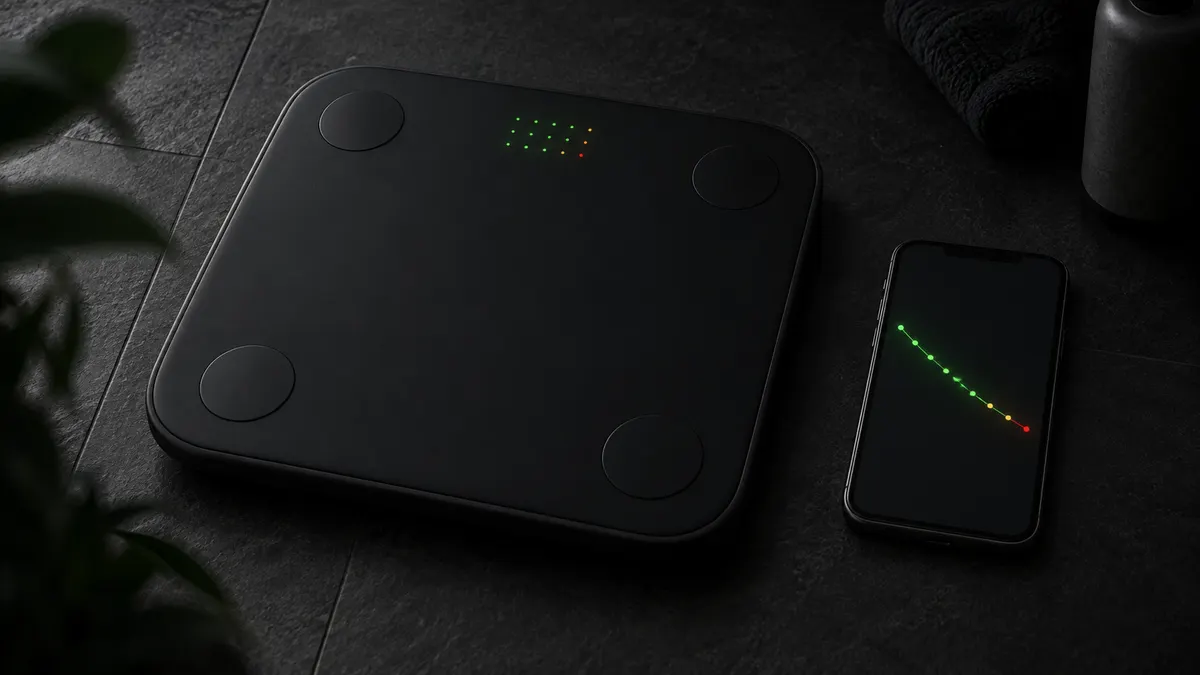
Losing weight helps snoring when extra weight is what narrows your airway, and the best long-term data put a number on it. In 690 Wisconsin adults followed for four years, a 10% weight loss predicted a 26% decrease in breathing events per hour, and a 10% gain a 32% increase (Peppard et al. 2000). That is a population trend, not a promise for one person, and thin people snore too. Whether it moves your snoring is a question for a scale and a recorder over 8 to 12 weeks.
- A 10% weight loss predicted a 26% decrease in the apnea-hypopnea index; a 10% gain predicted a 32% increase (Peppard et al. 2000, 690 adults, 4 years).
- In a trial of 72 overweight adults with mild sleep apnea, the 35 on a supervised diet took off 10.7 kg and cut their odds of still having mild apnea at one year to about a quarter, odds ratio 0.24 (Tuomilehto et al. 2009).
- In 264 obese adults with type 2 diabetes, a weight-loss program took off 10.8 kg in a year and lowered the apnea-hypopnea index from 22.9 to 18.3 events per hour; the education-only group rose from 23.5 to 28.3 (Foster et al. 2009).
- On MRI of 67 people before and after weight loss, the drop in tongue fat was the strongest predictor of the drop in breathing events, r = 0.62 (Wang et al. 2020).
- A neck over 40 cm (about 15.75 inches) is one of the eight STOP-Bang screening points for sleep apnea (Chung et al. 2008).
This article is part of a series on snoring fixes you can check with a recorder instead of a review. The numbers come from published sleep studies; we do not yet have Snorly data on weight and snoring, and will publish it when enough users log both.
Why does weight make snoring worse?
Fat narrows the airway from three sides: inside the tongue, which gets bigger and heavier, in the throat walls, which push inward, and around the neck, which adds weight on top. Lie down, let the muscles relax, and a bigger tongue in a narrower throat leaves a smaller gap; the soft tissue flutters in the faster airflow, and that flutter is the snore. The other causes are laid out in why do I snore.
The tongue is the part that surprises people. When Wang and colleagues scanned 67 people with obesity and sleep apnea before and after weight loss, tongue fat, pterygoid volume and the throat's side walls all shrank, but only the change in tongue fat tracked the change in breathing events, even after adjusting for kilograms lost. Belly fat travels with it, which is why waist size tracked breathing events in Kuopio too.
Does losing weight actually reduce snoring?
Yes, for people who carry extra weight, in proportion to how much they lose. The Wisconsin Sleep Cohort measured 690 people twice, four years apart, and modeled how breathing events moved with weight: 10% off predicted 26% fewer events, 10% on predicted 32% more.
Two randomized trials confirmed it with a diet. In Kuopio, Finland, 35 overweight adults with mild sleep apnea lost 10.7 kg on a supervised very low calorie diet; a year later their odds of still having mild apnea were about a quarter of the control group's (Tuomilehto et al. 2009). In Sleep AHEAD, 264 obese adults with type 2 diabetes were assigned to a weight-loss program or diabetes education. The program group lost 10.8 kg in a year and its breathing events fell; the education group lost 0.6 kg and its events rose (Foster et al. 2009).
| Apnea-hypopnea index, events per hour | Baseline | After 1 year | Change |
|---|---|---|---|
| Weight-loss program | 22.9 | 18.3 | -20% |
| Education only | 23.5 | 28.3 | 20% |
Remission, an index under 5, happened in 13.6% of the program group and 3.5% of the education group. These trials counted breathing events, not snore minutes; the two share the same narrowing, so the direction transfers, the exact percentages do not.
How much weight do I need to lose to stop snoring?
Nobody can tell you a number of kilograms. The Wisconsin model is linear in percent: for a 100 kg person, 5 kg is 5%, which predicts roughly 13% fewer breathing events; 10 kg predicts about 26%. The trials with big changes took off about 10 kg in a year, and in Sleep AHEAD the people who lost 10 kg or more improved most.
| Starting weight | 5% lost | 10% lost | Predicted change in breathing events |
|---|---|---|---|
| 70 kg | 3.5 kg | 7 kg | about 13% at 5%, 26% at 10% |
| 90 kg | 4.5 kg | 9 kg | about 13% at 5%, 26% at 10% |
| 110 kg | 5.5 kg | 11 kg | about 13% at 5%, 26% at 10% |
Read the table as odds, not a contract: the confidence interval for the 10% figure ran from 18% to 34%, and in every trial some people barely moved. Weight loss reduces snoring for most overweight people, stops it for some, and does nothing for snoring from a blocked nose, a small jaw or back sleeping. Those need their own fixes, ranked in how to stop snoring.
What does neck circumference have to do with it?
Neck size is the quickest proxy for fat around the airway. STOP-Bang, the eight-question sleep apnea screen used in clinics, scores one point for a neck over 40 cm, alongside snoring, tiredness, observed pauses, blood pressure, BMI over 35, age over 50 and male sex; three or more points is "high risk" (Chung et al. 2008). Measure at the Adam's apple with the tape level and snug, not tight.
A neck over 40 cm plus snoring with pauses on your recording is a reason to read snoring vs sleep apnea and talk to a doctor now, because weight loss is slow and apnea has faster treatments.
Why do thin people snore?
Because weight is one of six or so causes. A narrow nose, a small or set-back jaw, a long soft palate, large tonsils, evening alcohol, back sleeping and age-related loss of muscle tone all narrow the airway without a gram of extra fat; weight stacks on top of them. If your BMI is normal and you snore, the scale is the wrong tool: test position, alcohol timing and your nose first. If your BMI is high, weight is likely part of it, and the plan below tells you how much.
How to track weight and snoring together over 8 to 12 weeks
Snoring changes with weight over months, so the seven-night test used for strips and pillows is too short. Use it once for the baseline, then switch to weekly checkpoints.
| Week | Weigh-in | Recording | What to look at |
|---|---|---|---|
| 0 | Monday morning, after the bathroom, before breakfast | Nights 1 to 7, every night, phone on the nightstand 0.5 to 1 m away | Median snore minutes across the 7 nights, the loudest clip's label |
| 1 to 11 | Same day, same conditions, one number a week | At least 4 nights a week, no alcohol on those nights | Weekly median snore minutes, not the best or worst night |
| 12 | Final weigh-in | A full 7-night block again | Compare the two 7-night medians and the two weights |
Weigh once a week, because daily weight swings 1 to 2 kg with water and salt. Skip alcohol on recording nights; a drink can add a whole loudness band and hide a real trend. In Snorly the history screen shows snore minutes and the score per night, and each clip's loudness label tells you whether snores got quieter as well as shorter; any recorder with a nightly summary works.
Rule for calling it: compare the week-12 median to the week-0 median, never single nights. If you lost 5% or more and median snore minutes fell by a quarter or more, weight was part of your snoring. If the weight moved and the median did not, something else is holding the airway shut; test that next. The population figures behind these thresholds are on the snoring statistics page.
Snoring does not wait for the scale, so run a faster fix alongside on its own tagged nights: side sleeping, or the daily snoring exercises that halved the snore index in three months. A phone recording cannot tell you whether your oxygen dropped; silences of 10 seconds or more followed by a gasp are worth a doctor's visit now.
- Measure your neck at the Adam's apple and write it down; over 40 cm goes on your list for the doctor.
- Put the phone on the nightstand, plugged in, and record the whole night. Baseline night 1 of 7.
- No alcohol this evening, so the baseline is honest.
- Set a weekly weigh-in alarm for the same morning each week, before breakfast.
Hear your own snoring tonightSnorly records only when it hears snoring and plays it back in the morning. Free, no account, no night limit.
Download on the App StoreRelated questions
Will losing weight stop snoring completely?
For some overweight people, yes; for most it reduces it. In Sleep AHEAD, breathing events dropped under 5 per hour in 13.6% of the weight-loss group against 3.5% of controls, so most improved without stopping.
How much weight loss reduces snoring?
Each 10% of body weight lost predicted about 26% fewer breathing events in the Wisconsin cohort. The trials with the biggest changes took off about 10 kg over a year. There is no threshold; the effect is roughly proportional.
Does losing weight help sleep apnea?
It lowers the apnea-hypopnea index in proportion to weight lost; a 10.7 kg loss cut the odds of still having mild apnea to about a quarter at one year. It is slow, so moderate or severe apnea is usually treated with CPAP or a mouthpiece meanwhile. Apps cannot diagnose apnea; a sleep study can.
Sources
- Peppard PE, Young T, Palta M, Dempsey J, Skatrud J (2000). Longitudinal Study of Moderate Weight Change and Sleep-Disordered Breathing. JAMA 284(23):3015-3021. https://doi.org/10.1001/jama.284.23.3015
- Tuomilehto HP, Seppä JM, Partinen MM, et al. (2009). Lifestyle Intervention with Weight Reduction: First-line Treatment in Mild Obstructive Sleep Apnea. American Journal of Respiratory and Critical Care Medicine 179(4):320-327. https://doi.org/10.1164/rccm.200805-669OC
- Foster GD, Borradaile KE, Sanders MH, et al. (2009). A Randomized Study on the Effect of Weight Loss on Obstructive Sleep Apnea Among Obese Patients With Type 2 Diabetes: The Sleep AHEAD Study. Archives of Internal Medicine 169(17):1619-1626. https://pmc.ncbi.nlm.nih.gov/articles/PMC2879275/
- Wang SH, Keenan BT, Wiemken A, et al. (2020). Effect of Weight Loss on Upper Airway Anatomy and the Apnea-Hypopnea Index. The Importance of Tongue Fat. American Journal of Respiratory and Critical Care Medicine 201(6):718-727. https://doi.org/10.1164/rccm.201903-0692OC
- Chung F, Yegneswaran B, Liao P, et al. (2008). STOP Questionnaire: A Tool to Screen Patients for Obstructive Sleep Apnea. Anesthesiology 108(5):812-821. https://doi.org/10.1097/ALN.0b013e31816d83e4
- Guimarães KC, Drager LF, Genta PR, Marcondes BF, Lorenzi-Filho G (2009). Effects of Oropharyngeal Exercises on Patients with Moderate Obstructive Sleep Apnea Syndrome. American Journal of Respiratory and Critical Care Medicine 179(10):962-966. https://doi.org/10.1164/rccm.200806-981OC
Snorly is a snore recorder and tracker, not a medical device. It does not diagnose sleep apnea or any other condition. If you notice pauses in breathing, gasping or daytime sleepiness, talk to a doctor.