Humidifier or nasal spray for snoring? Which one helps

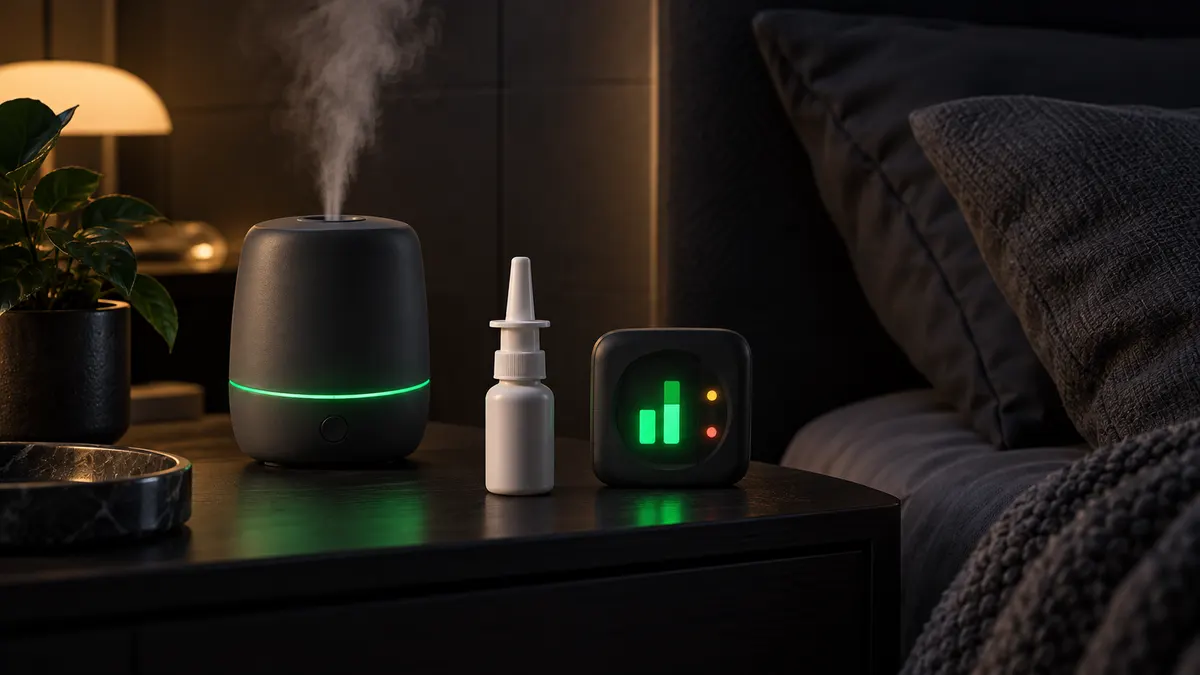
A blocked nose makes you snore, and the nasal fix with trial evidence is a steroid spray, not a humidifier. In 23 snorers with rhinitis, four weeks of fluticasone lowered the breathing-event index from a median of 20 to 11.9 per hour and lowered nasal resistance, though the snoring noise did not change (Kiely et al. 2004). Saline rinses ease congestion modestly, decongestant sprays work for three days and then backfire, and no humidifier trial has measured snoring at all. Seven recorded nights tell you which one your nose needs.
- Among 4,927 adults, rhinitis symptoms on 5 or more nights a month went with significantly more habitual snoring, and allergic congestion with 1.8 times the odds of moderate to severe sleep-disordered breathing (Young et al. 1997).
- Four weeks of fluticasone nasal spray lowered the apnea-hypopnea index from a median of 20 to 11.9 per hour and lowered nasal resistance in 23 snorers with rhinitis; snoring noise was unchanged (Kiely et al. 2004).
- A nasal steroid improved congestion and self-reported sleep in 20 allergic rhinitis patients in a double-blind placebo-controlled study (Craig et al. 1998).
- Daily 150 ml hypertonic saline irrigation improved sinus quality-of-life scores by 6.3 points at 3 months and 13.5 at 6 months out of 100, low-quality evidence; 23% of rinsers reported side effects such as nosebleeds (Chong et al. 2016, Cochrane).
- Opening a blocked nose with a decongestant and a dilator strip cut mouth breathing during sleep by 30 percentage points in 10 patients, but did not resolve their sleep apnea (McLean et al. 2005).
This is part of a series on remedies you can check with a recorder instead of a review: nasal strips, mouth tape and the anti-snoring mouthpiece. Snorly has no user data on nasal sprays or humidifiers yet; the numbers below are from published trials. When enough users have tagged these nights, we will add what they show.
Does a blocked nose make you snore?
Often, yes. In the Wisconsin sleep cohort, people with rhinitis symptoms on five or more nights a month were significantly more likely to be habitual snorers (Young et al. 1997). The mechanism is suction: a narrow nose pulls the throat inward and the mouth open. Opening the nose with a decongestant and a dilator strip cut mouth breathing during sleep by 30 percentage points in 10 patients (McLean et al. 2005). Mouth breathing turns a stuffy nose into a vibrating palate; the other causes are in why do I snore.
Does a steroid nasal spray stop snoring?
It lowers the obstruction; in the one crossover trial that recorded snoring noise, the noise did not fall. Kiely's group in Dublin gave 24 snorers with rhinitis four weeks each of fluticasone and placebo in random order, with a sleep study after each. Breathing events and nasal resistance fell on fluticasone, and diaries reported clearer noses and more daytime alertness; snoring noise and sleep quality did not change.
| Events per hour (AHI) | Placebo spray | Fluticasone | Change |
|---|---|---|---|
| Apnea-hypopnea index | 20 | 11.9 | -40% |
The practical reading: a steroid spray is for a nose swollen by allergy or chronic rhinitis, takes days to weeks, and its measured payoff is easier breathing and fewer pauses rather than a quieter microphone. A nose blocked on one side only, or that bleeds, is a reason to see a doctor, not to spray.
Saline spray, rinse or neti pot: is there a difference?
Volume. A saline spray puts a few drops on the front of the nose; a rinse bottle or neti pot pushes 150 ml or more through it, and the evidence follows the volume. For chronic sinus problems, daily 150 ml irrigation improved quality-of-life scores modestly on low-quality evidence, while a 5 ml nebulized spray was no match for a steroid spray (Chong et al. 2016). For colds, five trials in 544 children and 205 adults found mostly no difference (King et al. 2015).
Rinse water must be distilled, sterile, or tap water boiled for one minute (three minutes above 6,500 feet) and cooled; untreated tap water can carry an amoeba that has caused fatal infections through the nose (CDC).
Is a decongestant spray safe for snoring?
For three nights, yes; as a nightly habit, no. Oxymetazoline sprays shrink the nasal lining in minutes. The label limits use to three days because longer use causes rebound swelling, rhinitis medicamentosa, in which the nose is more blocked when the spray wears off than before (Graf 2007; Mayo Clinic). It is a fair tool for a cold week or a one-off test of whether your nose is the cause, not a fix.
Does a humidifier help with snoring?
No trial has measured snoring with and without a humidifier, so anyone who says it works is guessing. It adds water to dry bedroom air, which eases crusting and dryness in the nose and throat; Mayo Clinic puts the comfortable range at 30% to 50% humidity and warns that a dirty tank grows mold and bacteria, so clean it every few days and use distilled water. If you wake with a dry mouth in heated winter air, it may take the edge off. It does nothing for allergic swelling, so expect a small effect at most.
| Option | Targets | Evidence | Time to work | Limits |
|---|---|---|---|---|
| Steroid spray (fluticasone) | Swelling from allergy or chronic rhinitis | Kiely 2004: AHI 20 to 11.9, snoring noise unchanged; Craig 1998: sleep improved | Days to 2 weeks | Useless for a cold; works only if used nightly |
| Saline rinse, 150 ml or more | Mucus, crusting, sinus congestion | Chong 2016: quality of life up 6.3 to 13.5 points of 100, low quality | Same evening for mucus | Safe water only; 23% reported side effects |
| Saline spray | Dryness | King 2015: minimal, mostly no difference | Minutes, briefly | Too little volume to clear a blocked nose |
| Decongestant spray | Any swelling, short term | McLean 2005: mouth breathing down 30 points | Minutes | 3-day limit; rebound congestion after |
| Humidifier | Dry air | None for snoring | Hours | Needs cleaning; no effect on swelling |
When the nose is not the cause
Close one nostril and breathe in through the other with your mouth shut, then swap; if both sides stay open, the nose is probably not the bottleneck. Listen to your clips: nasal snoring is high, thin and whistling with the mouth closed, palate snoring is a low open-mouth flap, and the difference is in what snoring sounds like. Snoring that starts only after alcohol, or only after you roll onto your back, is a throat or position problem; the levers there are side sleeping, mouth tape and the anti-snoring mouthpiece.
How to test a nasal fix in 7 nights
Record every night with the phone in the same place, 0.5 to 1 m from your head, and change one thing. Three nights without give you a baseline range; four nights with show whether it moved. Saline, a decongestant and a humidifier act the same evening. A steroid spray does not: after the three baseline nights, spray nightly for two weeks, then record the four test nights while still spraying.
| Night | Nasal fix | Rules |
|---|---|---|
| 1 to 3 | None | Same bedtime within 30 minutes, no alcohol, usual pillow, record all night |
| 4 to 7 | One option only | Same rules; note whether you woke with a dry mouth |
Compare snore minutes, clip count and the loudest clip's label. In Snorly, tag nights 4 to 7 with the remedy and the app puts tagged nights next to untagged ones; the dry-mouth note shows whether you breathed through the nose. Any recorder with a nightly summary works for the same test.
Rule for calling it: if every test night has fewer snore minutes than your quietest baseline night, the nose was the cause; keep that fix. If the ranges overlap, move to the throat and position levers, not to a stronger spray.
- Put the phone on the nightstand, plugged in, and record with nothing in your nose. Baseline 1 of 3.
- Do the nostril test lying down and note which side was worse.
- If you own a decongestant spray, leave it in the drawer; it would hide the baseline.
- Buy a saline rinse bottle and a bottle of distilled water, not a humidifier, for night 4.

Hear your own snoring tonightSnorly records only when it hears snoring and plays it back in the morning. Free, no account, no night limit.
Download on the App StoreRelated questions
What is the best nasal spray for snoring?
For a nose swollen by allergy or chronic rhinitis, a steroid spray such as fluticasone, used nightly for at least two weeks; it lowered breathing events from 20 to 11.9 an hour. For a cold, saline or three nights of a decongestant.
Can I use nasal spray every night for snoring?
Steroid and saline sprays, yes. Decongestant sprays, no: the label limit is three days, and longer use brings rebound congestion that is worse than the original blockage.
Does a neti pot help with snoring?
It can, if mucus or sinus congestion blocks your nose; daily large-volume rinsing improved sinus quality of life in the Cochrane review on low-quality evidence. Use distilled, sterile or boiled water only, and expect a modest change.
Does a blocked nose cause sleep apnea?
It raises the risk: allergic congestion came with 1.8 times the odds of moderate to severe sleep-disordered breathing, and treating the nose lowered but did not remove breathing events in two small trials. Pauses and gasps on a recording are a reason for a sleep test; no app can diagnose apnea.
Sources
- Kiely JL, Nolan P, McNicholas WT (2004). Intranasal corticosteroid therapy for obstructive sleep apnoea in patients with co-existing rhinitis. Thorax 59(1):50-55. https://pmc.ncbi.nlm.nih.gov/articles/PMC1758841/
- Young T, Finn L, Kim H (1997). Nasal obstruction as a risk factor for sleep-disordered breathing. Journal of Allergy and Clinical Immunology 99(2):S757-762. https://doi.org/10.1016/s0091-6749(97)70124-6
- Craig TJ, Teets S, Lehman EB, Chinchilli VM, Zwillich C (1998). Nasal congestion secondary to allergic rhinitis as a cause of sleep disturbance and daytime fatigue and the response to topical nasal corticosteroids. Journal of Allergy and Clinical Immunology 101(5):633-637. https://doi.org/10.1016/s0091-6749(98)70171-x
- McLean HA, Urton AM, Driver HS, et al. (2005). Effect of treating severe nasal obstruction on the severity of obstructive sleep apnoea. European Respiratory Journal 25(3):521-527. https://doi.org/10.1183/09031936.05.00045004
- Chong LY, Head K, Hopkins C, et al. (2016). Saline irrigation for chronic rhinosinusitis. Cochrane Database of Systematic Reviews CD011995. https://doi.org/10.1002/14651858.CD011995.pub2
- King D, Mitchell B, Williams CP, Spurling GK (2015). Saline nasal irrigation for acute upper respiratory tract infections. Cochrane Database of Systematic Reviews CD006821. https://doi.org/10.1002/14651858.CD006821.pub3
- Graf PM (2007). Rhinitis medicamentosa. Clinical Allergy and Immunology 19:295-304. https://pubmed.ncbi.nlm.nih.gov/17153021/
- CDC. Sinus Rinsing for Health or Religious Practice. https://www.cdc.gov/naegleria/prevention/sinus-rinsing.html
- Mayo Clinic. Humidifiers: Ease skin, breathing symptoms. https://www.mayoclinic.org/diseases-conditions/common-cold/in-depth/humidifiers/art-20048021
- Mayo Clinic. Nasal spray addiction: Is it real? https://www.mayoclinic.org/diseases-conditions/nasal-polyps/expert-answers/nasal-spray-addiction/faq-20058247
Snorly is a snore recorder and tracker, not a medical device. It does not diagnose sleep apnea or any other condition. If you notice pauses in breathing, gasping or daytime sleepiness, talk to a doctor.