Best Anti-Snoring Devices: 8 Types Ranked by Evidence
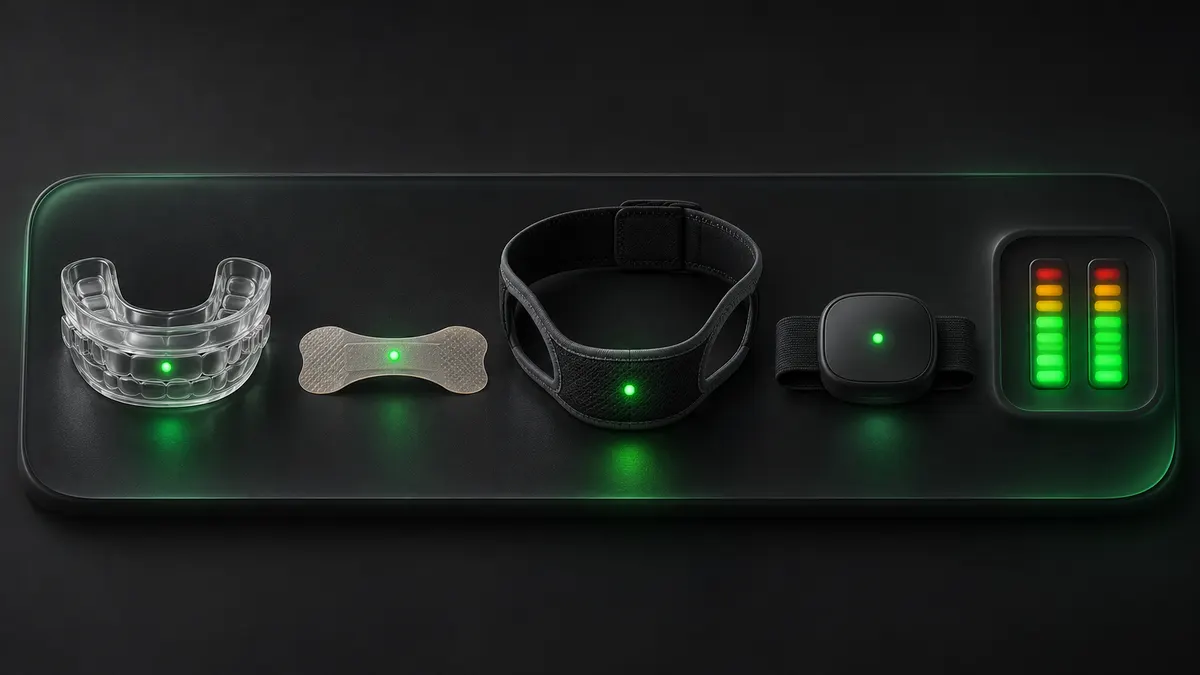
The best anti-snoring device for most people with their own teeth is a custom mandibular advancement device, fitted by a dentist. It has the strongest evidence for plain snoring, and in one home study it cut snoring from 193 to 20 snores an hour. CPAP is the strongest option when snoring comes with sleep apnea. Positional trainers suit people who only snore on their back. Chin straps have failed in a sleep lab. Below, eight device types are ranked by evidence, without brand reviews.
- The AASM and AADSM guideline recommends oral appliances over no treatment for adults who ask for help with primary snoring, and a custom adjustable device over a non-custom one (Ramar et al. 2015).
- The Australasian Sleep Association's 2023 statement calls mandibular advancement devices first-line for primary snoring, after a dental check and a sleep physician's assessment (Sarkis et al. 2023).
- A custom device succeeded in 60% of patients against 31% for a boil-and-bite device; a third could not keep the boil-and-bite in overnight (Vanderveken et al. 2008).
- A chin strap alone did not change the snoring index or breathing events in 26 patients in a sleep lab (Bhat et al. 2014).
- Of 115 snorers in the trial behind the FDA's 2021 authorization of eXciteOSA, a daytime tongue stimulator, 87 cut the time spent snoring above 40 dB by more than 20%.
Do anti-snoring devices really work?
Some do, and the gap between the best and the worst is large. Devices that move the jaw, the tongue or your sleeping position have trial data behind them. Devices that only claim to work through pressure points or vibration usually do not. Results also depend on the cause: a device that fixes a narrow nose does nothing for a floppy palate.
We rank device types here rather than brands, because the trials tested types, and we have not run our own head-to-head test. Brand names appear only where a study or a regulator used them. Snorly is an app, so it is not in the ranking; recording is simply how you check the result.
Anti-snoring devices ranked
| # | Device | What it does | Evidence | Best for |
|---|---|---|---|---|
| 1 | Custom mandibular advancement device | Holds the lower jaw forward, adjustable | Strong: 193 to 20 snores/h (Stradling 1998); first-line in two guidelines | Most snorers with their own teeth |
| 2 | CPAP | Pressurized air holds the airway open | Strong, mostly in people with apnea; an option for snoring if you are willing (Sarkis 2023) | Snoring with sleep apnea |
| 3 | Vibrating position trainer | Buzzes when you roll onto your back | Moderate: a reasonable, low-risk trial for back snorers (Sarkis 2023) | People who snore only on their back |
| 4 | Tongue retaining device | Holds the tongue forward by suction | Moderate: 45% response vs 68% for a jaw device (Deane 2009) | Dentures, few teeth, jaw problems |
| 5 | Nasal dilators, strips and cones | Open the nasal valve | Mixed: 258 to 173 snores/h in one trial; pooled result not significant | A narrow or blocked nose |
| 6 | Boil-and-bite mouthpiece | Holds the jaw forward in one position | Weak: 31% success vs 60% custom (Vanderveken 2008) | A cheap first look at the idea |
| 7 | Daytime tongue stimulator | Trains tongue muscles while awake | Early: 87 of 115 improved by more than 20%, before-and-after data | Snoring or mild apnea, on prescription |
| 8 | Chin strap | Holds the mouth closed | None: no change in a sleep lab (Bhat 2014) | Nobody as a stand-alone fix |
Evidence labels are our summary of the studies below. Anti-snoring pillows have their own page; a memory foam pillow cut snoring events by 47% in one small trial, covered in do anti-snoring pillows work.
Why is a custom mouthpiece first?
A custom mandibular advancement device is first because it has the most evidence and works for the widest group. It holds the lower jaw a few millimeters forward, which pulls the tongue base out of the airway. Two guidelines back it for primary snoring, and a dentist fits it and adjusts it over time.
| Snores per hour | Without device | With device | Change |
|---|---|---|---|
| Median snoring rate | 193 | 20 | -90% |
The catch is the cost and the fitting. You need enough healthy teeth to anchor it, and your jaw may ache at first. The guideline asks for dental follow-up because the bite can shift. A sleep physician should rule out apnea first. Our guide to anti-snoring mouthpieces goes through the trials and the custom vs ready-made gap.
When is CPAP the right device?
CPAP is the right device when your snoring comes with sleep apnea. It holds the airway open with air pressure, and on mask nights snoring usually stops. For plain snoring, the Australasian statement treats it as an option if you are willing to try it, since most of the research comes from people with apnea.
Most people who snore do not need a machine. Pauses, gasps and daytime sleepiness are the signs that you should get tested before buying anything else. An over-the-counter device can reduce the noise and leave the apnea untreated, so the sound stops being a warning.
Do position trainers work for snoring?
Yes, if you snore mainly on your back. A small device on the chest buzzes when you roll over until you turn. In 31 patients with positional sleep apnea, one month with a trainer cut breathing events from 16.4 to 5.2 an hour and took time on the back from about half the night to nearly zero (van Maanen 2013).
Those were apnea patients, and snoring itself has been studied less, so the Australasian statement calls it a reasonable low-risk trial and no more. A timeline makes this easy to spot: if a recording gets loud only in the middle of the night, when you roll onto your back, this is your device. See sleeping position to stop snoring.
Are nasal dilators worth trying?
Yes, as a cheap test when your nose is the bottleneck. A strip pulls the nasal valve open from outside and a cone or clip does it from inside. One randomized trial in chronic rhinitis took snoring from 258 to 173 snores an hour. A pooled analysis of five sleep-lab studies showed a drop that did not reach significance.
The spread between people is wide, which is why a test beats an average. If you snore with your mouth closed or your nose blocks at night, try a strip for a week. If the recording does not change, move on. Details in do nasal strips work.
What about rings, wristbands and sprays?
Skip rings, wristbands and magnetic clips unless a seller shows you a controlled trial. We found no trials of them in the guidelines above. The Australasian statement says over-the-counter complementary remedies do little harm but have uncertain long-term use, and it does not advise them. Throat sprays and nasal lubricants sit in that group.
Nasal EPAP valves, disposable one-way valves worn over the nostrils, are a different case. The same statement says they have some effect in studies, mostly of apnea, at a steep long-term cost. Be careful with any product that promises to end snoring for good. A device works only while you use it.
How do you test a device in 7 nights?
Run it as a small experiment, because the only result that matters is yours. Change one thing at a time, keep alcohol and sleeping position steady, and record every night with the phone in the same spot. No app measures airflow, but a recording does show whether you got quieter and how often you snored.
| Nights | What you do | What to compare |
|---|---|---|
| 1 to 3 | Sleep as usual, no device | Snoring time and loudest clip, as your baseline |
| 4 to 7 | Wear the device, nothing else changes | Same numbers, plus how the device felt in the morning |
Give a mouthpiece a little longer, since the first nights are an adjustment. If the numbers barely move after 2 weeks, it is the wrong device for your cause. How to stop snoring ranks the non-device fixes to try alongside it.
- Record a baseline before buying anything. Put the phone 0.5 to 1 m from your head, plugged in.
- Listen for pauses followed by a gasp. If you hear them, see a doctor first.
- Note when the snoring is loudest. Mid-night only points to position; mouth open points to the jaw or nose.
- Pick the one device that matches that cause, and test it alone for a week.
Hear your own snoring tonightSnorly records only when it hears snoring and plays it back in the morning. Free, no account, no night limit.
Download on the App StoreRelated questions
What is the most effective anti-snoring device?
For plain snoring, a custom mandibular advancement device fitted by a dentist has the strongest evidence. For snoring with sleep apnea, CPAP is stronger. The best one for you depends on the cause, so record a few nights before you buy.
Do anti-snoring mouthpieces work without a dentist?
Boil-and-bite mouthpieces work less often. In a crossover trial, 31% of patients succeeded with one against 60% with a custom device, and a third could not keep it in overnight. It is a cheap way to try the idea, not a reliable predictor.
Is there an FDA-authorized device for snoring?
Yes. In 2021 the FDA authorized eXciteOSA, a prescription daytime mouthpiece that stimulates the tongue, for snoring and mild sleep apnea in adults. Authorization means a device met the FDA's bar for its claim, and it does not mean it suits you.
Are anti-snoring rings a scam?
We found no controlled trial showing they work, and guidelines do not recommend them. They are unlikely to hurt you, but your money is better spent on a nasal strip or a positional fix you can measure.
Can an anti-snoring device hide sleep apnea?
It can. A device may make you quieter while pauses in breathing continue. If you have gasps, witnessed pauses or daytime sleepiness, get tested first. See snoring vs sleep apnea.
Sources
- Ramar K, Dort LC, Katz SG, et al. (2015). Clinical Practice Guideline for the Treatment of Obstructive Sleep Apnea and Snoring with Oral Appliance Therapy: An Update for 2015. Journal of Clinical Sleep Medicine 11(7):773-827. https://pmc.ncbi.nlm.nih.gov/articles/PMC4481062/
- Sarkis LM, Jones AC, Ng A, et al. (2023). Australasian Sleep Association position statement on consensus and evidence based treatment for primary snoring. Respirology 28:110. https://pmc.ncbi.nlm.nih.gov/articles/PMC10108143/
- Stradling JR, Negus TW, Smith D, Langford B (1998). Mandibular advancement devices for the control of snoring. European Respiratory Journal 11(2):447-450. https://doi.org/10.1183/09031936.98.11020447
- Vanderveken OM, Devolder A, Marklund M, et al. (2008). Comparison of a custom-made and a thermoplastic oral appliance for the treatment of mild sleep apnea. American Journal of Respiratory and Critical Care Medicine 178(2):197-202. https://doi.org/10.1164/rccm.200701-114OC
- Deane SA, Cistulli PA, Ng AT, et al. (2009). Comparison of mandibular advancement splint and tongue stabilizing device in obstructive sleep apnea: a randomized controlled trial. Sleep 32(5):648-653. https://doi.org/10.1093/sleep/32.5.648
- Bhat S, Gushway-Henry N, Polos PG, et al. (2014). The efficacy of a chinstrap in treating sleep disordered breathing and snoring. Journal of Clinical Sleep Medicine 10(8):887-892. https://doi.org/10.5664/jcsm.3962
- van Maanen JP, Meester KA, Dun LN, et al. (2013). The sleep position trainer: a new treatment for positional obstructive sleep apnoea. Sleep and Breathing 17(2):771-779. https://doi.org/10.1007/s11325-012-0764-5
- Pevernagie D, Hamans E, Van Cauwenberge P, Pauwels R (2000). External nasal dilation reduces snoring in chronic rhinitis patients: a randomized controlled trial. European Respiratory Journal 15(6):996-1000. https://doi.org/10.1034/j.1399-3003.2000.01504.x
- Camacho M, Malu OO, Kram YA, et al. (2016). Nasal Dilators (Breathe Right Strips and NoZovent) for Snoring and OSA: A Systematic Review and Meta-Analysis. Pulmonary Medicine. https://pmc.ncbi.nlm.nih.gov/articles/PMC5187471/
- U.S. FDA (5 February 2021). FDA authorizes marketing of novel device to reduce snoring and mild obstructive sleep apnea, release text via BioSpace. https://www.biospace.com/fda-authorizes-marketing-of-novel-device-to-reduce-snoring-and-mild-obstructive-sleep-apnea-in-patients-18-years-and-older
Snorly is a snore recorder and tracker, not a medical device. It does not diagnose sleep apnea or any other condition. If you notice pauses in breathing, gasping or daytime sleepiness, talk to a doctor.