Do anti-snoring mouthpieces work? Tested by recording

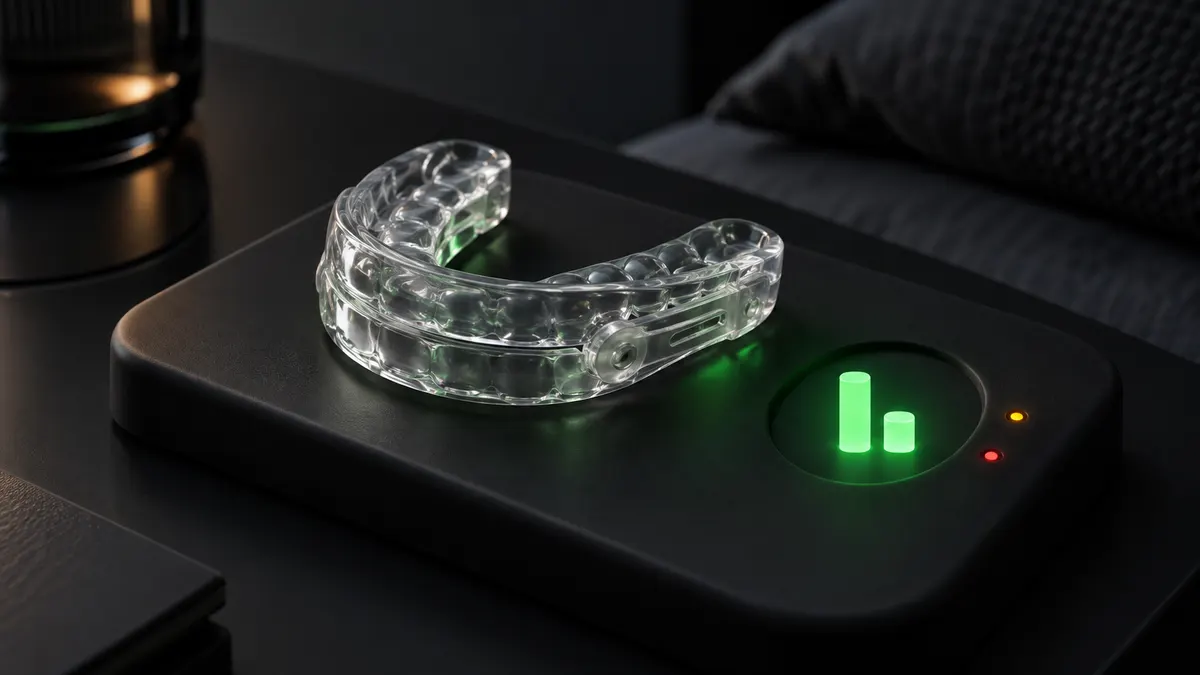
Anti-snoring mouthpieces work when they hold your lower jaw or tongue forward during sleep, and the custom-made kind works best. In 15 snorers measured at home with a throat microphone, a mandibular advancement device cut snoring from a median of 193 snores an hour to 20 (Stradling et al. 1998). Boil-and-bite copies fail in most people, tongue retainers work but are hard to keep in, and a chin strap changes nothing measurable. Whether yours works is a seven-night recording, and this is how to run it.
- The AASM and AADSM guideline recommends oral appliances rather than no treatment for adults who ask for help with plain snoring, and a custom, adjustable device over a non-custom one (Ramar et al. 2015).
- In 15 established users, a mandibular advancement device reduced snoring from a median of 193 to 20 snores per hour on home recordings (Stradling et al. 1998).
- In a 96-patient placebo-controlled trial, snoring was less frequent with a custom adjustable device than with a placebo device after 4 months, and the breathing index fell below 5 events an hour in 49% of users versus 11% on placebo (Marklund et al. 2015).
- A custom device succeeded in 60% of patients against 31% for a boil-and-bite device, and a third of patients could not keep the boil-and-bite in overnight (Vanderveken et al. 2008).
- A chin strap alone did not change the snoring index or the number of breathing events in 26 patients measured in a sleep lab (Bhat et al. 2014).
This article is part of a series on remedies you can check with a recorder instead of a review: mouth tape, nasal strips, the anti-snoring pillow and nasal sprays and humidifiers. Snorly has no user data on mouthpieces yet; every number below comes from a published trial. When enough users have tagged mouthpiece nights, we will add what those nights show.
What the studies measured
The cleanest snoring number comes from Oxford. Fifteen established users slept two nights at home with a throat microphone, one with the device and one without, in random order. Snores per hour fell from a median of 193 to 20, and breathing effort fell with it, which means the airway was wider. The catch is the selection: all 15 had already proved they could tolerate the device.
| Snores per hour | Without device | With device | Change |
|---|---|---|---|
| Median snoring rate | 193 | 20 | -90% |
The placebo-controlled answer comes from Umeå, Sweden: 96 patients with snoring or mild to moderate apnea wore a custom adjustable device or a placebo device for four months. Snoring was less frequent with the real device (p < 0.001), and the breathing index dropped below 5 events an hour in 49% of users against 11% on placebo. Daytime sleepiness did not improve more than on placebo (Marklund et al. 2015): a mouthpiece quiets the night, it does not promise a livelier day.
Custom vs boil-and-bite: does the cheap one work?
Rarely as well, and often not at all. In Antwerp, 35 patients wore a thermoplastic boil-and-bite device and a dentist-made device for four months each, in random order. The custom device succeeded in 60% of patients, the boil-and-bite in 31%; a third could not keep the boil-and-bite in overnight, and 82% preferred the custom one. The authors concluded the thermoplastic device could not be recommended, even as a screening tool for the custom one (Vanderveken et al. 2008).
A London crossover of 25 patients found the same gap: a complete response in 64% with the custom device against 24% with the ready-made one, failure in 4% against 36%, and more nights and more hours of use with the custom one (Johal et al. 2017).
| % of patients | Boil-and-bite | Custom-made | Change |
|---|---|---|---|
| Vanderveken 2008 | 31 | 60 | 94% |
| Johal 2017 | 24 | 64 | 167% |
Both trials scored success by breathing events rather than snores, because the patients had mild apnea. The lesson for a plain snorer is the same: the device that stays in and holds the jaw at a set position is the one that works.
Mandibular advancement device, tongue retainer or chin strap?
| Device | What it moves | Evidence | Fits best | Watch-outs |
|---|---|---|---|---|
| Custom mandibular advancement device (MAD) | Lower jaw forward, adjustable in millimeters | Stradling 1998: 193 to 20 snores/h; Marklund 2015: snoring less frequent than placebo | Most snorers with their own teeth | Jaw and tooth soreness at first; the guideline asks for dental follow-up because the bite can shift (Ramar 2015) |
| Boil-and-bite MAD | Lower jaw forward, one fixed position | Vanderveken 2008: 31% success vs 60% custom; a third could not keep it in | A cheap first look at the jaw-forward idea | Falls out, bulky, fails in most; not a reliable predictor for the custom version |
| Tongue retaining device (TRD) | Tongue forward, held by a suction bulb | Deane 2009: 45% response vs 68% for a MAD; Lazard 2009: reported snoring intensity down 68% | People with dentures, few teeth or jaw joint problems | Needs a clear nose; 52% still using it at 5 years (Lazard 2009) |
| Chin strap | Holds the mouth closed, moves nothing | Bhat 2014: no change in snoring index or breathing events | Nobody as a stand-alone fix | Sold as a snoring fix with no sleep-lab support |
Choose by teeth and nose. A mandibular device needs enough healthy teeth to anchor on. A tongue retainer suits people with dentures or jaw problems, but you breathe through your nose with it in, so a blocked nose rules it out; Lazard's group listed nasal obstruction as a contraindication. In the head-to-head trial, 91% of patients preferred the mandibular device (Deane et al. 2009). A chin strap moves nothing, which is why the sleep-lab numbers did not move either.
What a mouthpiece cannot do
It cannot tell you whether your snoring is sleep apnea, and neither can a recording. The AASM guideline pairs oral appliances with follow-up sleep testing because a quieter night is not proof that the breathing is fixed. Snoring that stops for 10 seconds or more and restarts with a gasp is a reason for a sleep test before any device; the pattern is described in snoring vs sleep apnea.
It also cannot open a blocked nose; a person who cannot breathe through the nose pulls the mouth open around the device. Clear the nose first, with the options in humidifier or nasal spray and nasal strips, then test the mouthpiece.
How to test a mouthpiece in 7 nights
Record every night with the phone in the same spot, 0.5 to 1 m from your head, and change only the device. Three nights without give you a baseline range; four nights with show whether the range moved. Mouthpieces have an adjustment period, so treat the first few nights of wear as practice and start the test nights only once you can keep the device in all night.
| Night | Mouthpiece | Rules |
|---|---|---|
| 1 to 3 | No | Same bedtime within 30 minutes, no alcohol, usual pillow, record all night |
| 4 to 7 | Yes | Same rules; note any night you took it out, and any jaw or tooth soreness in the morning |
Compare snore minutes, clip count and the loudest clip's label. In Snorly, tag nights 4 to 7 with the mouthpiece as a remedy and the app lines tagged nights up against untagged ones. A device that comes out at 3 a.m. shows up as a quiet first half and a loud second half. Any recorder with a nightly summary works for the same test.
Rule for calling it: if every mouthpiece night has fewer snore minutes than your quietest baseline night, it is working, and a boil-and-bite that passes is a reason to ask a dentist about a custom one. If the ranges overlap, the jaw is not your lever, and the ranked list in how to stop snoring is the next stop.
- Put the phone on the nightstand, plugged in, and record a night without any device. Baseline 1 of 3.
- Try the jaw check: make a snoring sound with your mouth slightly open, then push your lower jaw forward and try again. If it gets harder, a jaw-forward device is a plausible fit.
- Check that you can breathe through your nose lying down. If not, the nose comes first.
- Do not buy anything yet. Three baseline nights, then the device, then the comparison.
Hear your own snoring tonightSnorly records only when it hears snoring and plays it back in the morning. Free, no account, no night limit.
Download on the App StoreRelated questions
What is the best anti-snoring mouthpiece?
A custom, adjustable mandibular advancement device made by a dentist, by both the AASM guideline and the head-to-head trials: 60% success against 31% for a boil-and-bite in one crossover, 64% against 24% in another.
Do chin straps work for snoring?
Not on their own. In 26 patients measured in a sleep lab, a chin strap changed neither the snoring index nor the breathing events, mild cases included. Holding the mouth closed for a CPAP user is a different job.
Is a snoring mouth guard the same as a night guard for grinding?
No. A grinding guard covers the teeth and leaves the jaw where it is; a snoring mouthpiece holds the lower jaw forward. A guard that does not advance the jaw has no reason to change snoring, and a recording will show that.
How long does a mandibular advancement device take to work?
The first full night it stays in. There is nothing to build up; the Oxford trial measured the effect on a single night. Comfort takes a week or two, so run the four test nights after the adjustment period.
Do mouthpieces work for sleep apnea?
Custom devices are a recognized option for mild to moderate sleep apnea in people who cannot use CPAP, prescribed by a sleep physician and checked with a follow-up sleep test. No app can diagnose apnea; snoring with pauses and gasps on a recording is a reason for a sleep study, not a pharmacy purchase.
Sources
- Ramar K, Dort LC, Katz SG, et al. (2015). Clinical Practice Guideline for the Treatment of Obstructive Sleep Apnea and Snoring with Oral Appliance Therapy: An Update for 2015. Journal of Clinical Sleep Medicine 11(7):773-827. https://doi.org/10.5664/jcsm.4858
- Stradling JR, Negus TW, Smith D, Langford B (1998). Mandibular advancement devices for the control of snoring. European Respiratory Journal 11(2):447-450. https://doi.org/10.1183/09031936.98.11020447
- Marklund M, Carlberg B, Forsgren L, et al. (2015). Oral Appliance Therapy in Patients With Daytime Sleepiness and Snoring or Mild to Moderate Sleep Apnea: A Randomized Clinical Trial. JAMA Internal Medicine 175(8):1278-1285. https://doi.org/10.1001/jamainternmed.2015.2051
- Vanderveken OM, Devolder A, Marklund M, et al. (2008). Comparison of a custom-made and a thermoplastic oral appliance for the treatment of mild sleep apnea. American Journal of Respiratory and Critical Care Medicine 178(2):197-202. https://doi.org/10.1164/rccm.200701-114OC
- Johal A, Haria P, Manek S, Joury E, Riha R (2017). Ready-Made Versus Custom-Made Mandibular Repositioning Devices in Sleep Apnea: A Randomized Clinical Trial. Journal of Clinical Sleep Medicine 13(2):175-182. https://doi.org/10.5664/jcsm.6440
- Deane SA, Cistulli PA, Ng AT, et al. (2009). Comparison of mandibular advancement splint and tongue stabilizing device in obstructive sleep apnea: a randomized controlled trial. Sleep 32(5):648-653. https://doi.org/10.1093/sleep/32.5.648
- Lazard DS, Blumen M, Lévy P, et al. (2009). The tongue-retaining device: efficacy and side effects in obstructive sleep apnea syndrome. Journal of Clinical Sleep Medicine 5(5):431-438. https://pubmed.ncbi.nlm.nih.gov/19961027/
- Bhat S, Gushway-Henry N, Polos PG, et al. (2014). The efficacy of a chinstrap in treating sleep disordered breathing and snoring. Journal of Clinical Sleep Medicine 10(8):887-892. https://doi.org/10.5664/jcsm.3962
Snorly is a snore recorder and tracker, not a medical device. It does not diagnose sleep apnea or any other condition. If you notice pauses in breathing, gasping or daytime sleepiness, talk to a doctor.