How to stop snoring: 9 fixes ranked by evidence

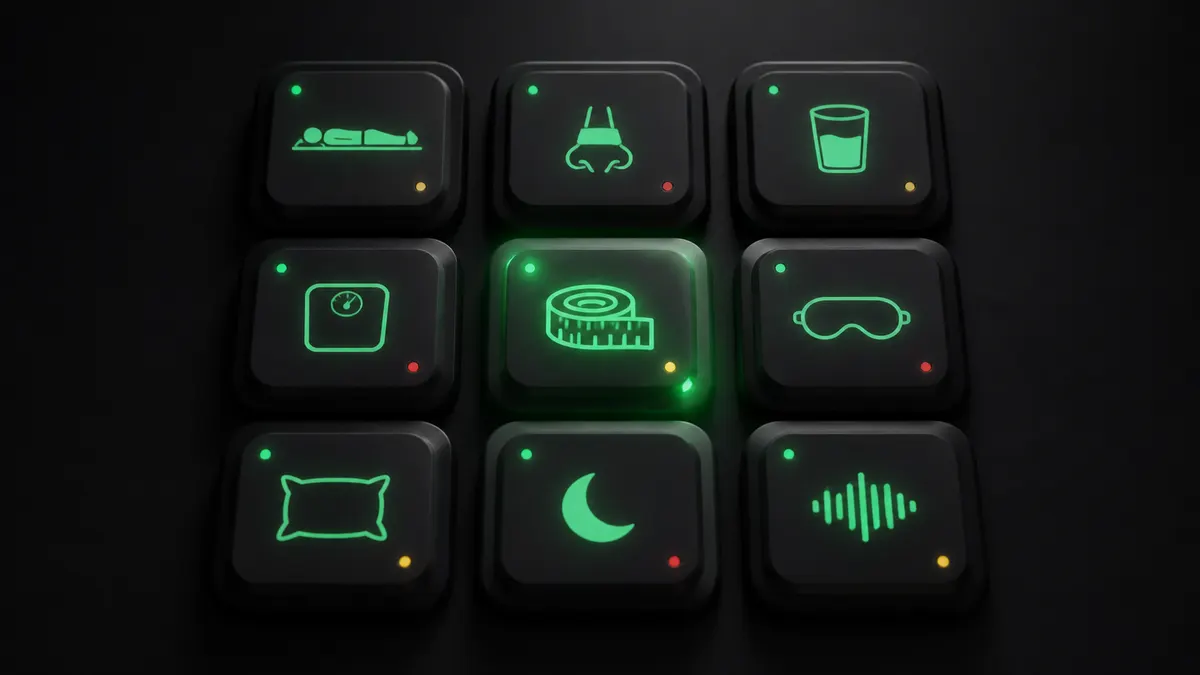
The fixes that stop snoring are the ones that match its cause, and most people try them in the wrong order. For everyday snoring, side sleeping, alcohol timing and weight carry the strongest evidence; a mandibular advancement device and CPAP take over when snoring comes with sleep apnea. A 10% weight loss predicted a 26% drop in breathing events over four years (Peppard et al. 2000). Here are nine fixes ranked by evidence, each with a 3-night way to check whether it worked for you.
- 55.9% of 574 sleep apnea patients had at least twice as many breathing events on their back as on their side (Oksenberg et al. 1997).
- A 10% weight loss predicted a 26% decrease in the apnea-hypopnea index; a 10% gain predicted a 32% increase (Peppard et al. 2000, 690 adults).
- Three months of daily throat exercises halved the objective snore index, from 99.5 to 48.2 snores per hour, in a randomized trial of 39 patients (Ieto et al. 2015).
- Oral appliances are recommended for adults with primary snoring who want treatment (AASM and AADSM guideline, Ramar et al. 2015).
Why measure before you fix anything?
Because snoring has at least six common causes and each fix targets one. Nasal strips do nothing for a tongue that falls back; a mouthpiece does nothing for a blocked nose. Without a baseline you cannot tell a fix that worked from a night you happened to sleep on your side.
Record three ordinary nights first with a snore recorder on the nightstand. Note the score, the number of snore clips, the minutes of snoring on the timeline and the loudness label of the loudest clip. That is your range. Then change one thing for three nights and compare. Not sure you snore at all? Start with how to tell if you snore; to narrow the cause, read why do I snore.
The 9 fixes at a glance
| # | Fix | Evidence | Best for | 3-night check |
|---|---|---|---|---|
| 1 | Sleep on your side | Strong | Snoring in bursts | Back nights vs side nights |
| 2 | Lose weight if you carry extra | Strong | Snoring that grew with the scale | A month, not 3 nights |
| 3 | Stop alcohol 2 to 3 hours before bed | Strong | Louder snoring on drink nights | Drink nights vs dry nights |
| 4 | Treat nasal congestion | Moderate | Mouth open on waking | Rinse or spray nights vs none |
| 5 | Nasal strips or dilators | Weak to moderate | Nasal snorers | Strip nights vs none |
| 6 | Mouth tape | Small studies, mouth breathers only | Dry mouth on waking, clear nose | 3 nights off, 4 on |
| 7 | Mandibular advancement device | Strong, guideline-recommended | Jaw-back snorers, mild to moderate apnea | Device nights vs none, after a week |
| 8 | CPAP | Strongest, for sleep apnea | Snoring with pauses and gasps | Near-zero snoring on mask nights |
| 9 | Surgery | Variable, can fade | Anatomical cause, everything else failed | Record before and 3 months after |
Fixes 1 to 5: what you can change yourself
1. Sleep on your side
On your back, gravity pulls the tongue and soft palate into the airway. In Oksenberg's series of 574 patients, 55.9% had at least twice as many breathing events on their back as on their side, and the effect was strongest in thinner, younger, milder cases, which describes most plain snorers. A body pillow is the cheapest tool; the pillows with sleep-lab data are compared in do anti-snoring pillows work. A phone cannot see your position, so tag the nights you know you slept on your back and compare.
2. Lose weight if you carry extra
Fat around the neck and tongue narrows the airway from outside. In the Wisconsin cohort, a 10% weight loss predicted a 26% decrease in breathing events and a 10% gain a 32% increase. This is the one fix you cannot verify in three nights: compare a month of recordings against a month a few kilograms later, with everything else constant.
3. Stop alcohol 2 to 3 hours before bed
Alcohol relaxes the muscles that hold the airway open and dulls the arousal that would normally end a snore. Meta-analyses summarized by Sleep Foundation show more breathing events and lower oxygen after evening drinking. Mayo Clinic advises avoiding alcohol at least two hours before bedtime; the earlier the last drink, the more is cleared by the time you lie down. Tag drink nights and compare loudest-clip labels: for many people a wine night is a whole loudness band louder.
4. Treat nasal congestion
A blocked nose forces mouth breathing, and mouth breathing drops the jaw. A saline rinse before bed costs nothing; a steroid nasal spray for allergic rhinitis is an over-the-counter step up, and a persistent block is worth an ENT visit. Compare three rinse-and-spray nights against baseline; a nasal cause usually shows as a higher-pitched snore that disappears.
5. Nasal strips or dilators
The trial numbers and a seven-night strip test are in do nasal strips work for snoring.
Strips lift the nostrils from outside; internal dilators hold them open from inside. A 2016 systematic review found they improve snoring for some people, mostly by self-report, with little change in breathing events, and Sleep Foundation notes they are less useful for snoring from deeper in the throat. They rank below fixing congestion because they treat a narrow nose rather than the reason it is narrow.
Fixes 6 to 9: tape, devices, machines and surgery
6. Mouth tape, for mouth breathers only
In 20 mouth breathers with mild apnea, a week of taping cut the snoring index by 47%, from 303.8 to 121.1 events per hour (Lee et al. 2022). A 2025 systematic review found only 10 small studies and warned that taping with a blocked nose carries an asphyxiation risk. So: only if you can breathe through your nose for three minutes with your mouth shut, only on alcohol-free nights, never if your recording shows pauses and gasps. The safety list and 7-night protocol are in does mouth tape stop snoring.
7. Mandibular advancement device
A mouthpiece that holds the lower jaw slightly forward pulls the tongue base out of the airway. The 2015 AASM and AADSM guideline recommends oral appliances for adults with primary snoring who want treatment, and for sleep apnea when CPAP is not tolerated, with custom, adjustable devices preferred over boil-and-bite. Expect a week of jaw soreness before judging it, then compare device nights with baseline.
8. CPAP
For snoring caused by obstructive sleep apnea, continuous positive airway pressure is the standard treatment (Mayo Clinic). It splints the airway open with air, so snoring on mask nights typically falls to near zero. It needs a sleep study and a prescription; a phone recording can show a snore-silence-gasp pattern worth discussing, but apps cannot diagnose apnea or measure oxygen. If you already have a machine and still snore, the mask is leaking or the pressure needs review.
9. Surgery
Procedures range from radiofrequency stiffening of the palate to uvulopalatopharyngoplasty and tonsil removal. Mayo Clinic notes that results vary and some benefits fade over time, which is why surgery sits last: it is for a clear anatomical cause after the fixes above have failed. Record a month before and three months after, so the surgeon sees the same evidence.
What does not work, or has no evidence?
Anti-snoring rings, throat sprays, pillows sold as snore-stoppers, and most chin straps have no controlled evidence. Throat exercises are the exception among cheap options: in a randomized trial, three months of daily oropharyngeal exercises halved the objective snore index while the control group did not change. They take about 8 minutes a day and pay off after weeks, so test them over a month.
"Stop snoring immediately" is a search phrase, not a treatment. The closest thing to an instant fix is a side-sleeping setup and no alcohol tonight; everything else takes days to weeks to prove.
When does snoring need a doctor rather than a fix?
When the recording shows silences of ten seconds or more followed by a loud snort or gasp, when you wake unrefreshed or with headaches, when you doze during the day, or when your neck is over 16 inches and your blood pressure is high. Those are STOP-BANG screening signals, and they point to sleep apnea, which the fixes above do not treat. Snorly marks pause-and-gasp patterns as "worth discussing with a professional" and can export a PDF of your nights; the snoring vs sleep apnea article shows the pattern on the timeline.
- Put your phone on the nightstand, plugged in, and record the whole night. Baseline night 1 of 3, change nothing yet.
- No alcohol from 2 to 3 hours before bed, and note it.
- Set up a body pillow so you fall asleep on your side, and note whether you woke on your back.
- If your nose feels blocked, rinse with saline and write that down too.
- In the morning, note score, clip count, snore minutes and the loudest clip's label. Two more nights, then change one thing.
Hear your own snoring tonightSnorly records only when it hears snoring and plays it back in the morning. Free, no account, no night limit.
Download on the App StoreRelated questions
How can I stop snoring immediately?
You cannot stop it in a night with certainty, but the fastest levers are sleeping on your side with a body pillow, no alcohol this evening, and a saline rinse if your nose is blocked. Record the night so you know whether any of them worked instead of guessing.
Can snoring stop naturally, without devices?
Snoring caused by position, alcohol, congestion or extra weight often stops when those change. Snoring from jaw shape or sleep apnea needs a device or medical treatment. Three nights of recording per change tells you which kind you have.
Do throat exercises stop snoring?
They reduce it. In a randomized trial, daily oropharyngeal exercises for three months halved the objective snore index, while nasal strips plus breathing exercises did not change it. The catch is consistency: about 8 minutes every day for weeks before the recordings move.
Do anti-snoring devices actually work?
Custom mandibular advancement devices do, and are guideline-recommended for primary snoring. Nasal dilators help some nasal snorers by self-report. Rings, sprays and most chin straps have no controlled evidence. Whatever you buy, test it against three baseline nights.
Sources
- Peppard PE, Young T, Palta M, Dempsey J, Skatrud J (2000). Longitudinal Study of Moderate Weight Change and Sleep-Disordered Breathing. JAMA. https://doi.org/10.1001/jama.284.23.3015
- Oksenberg A, Silverberg DS, Arons E, Radwan H (1997). Positional vs Nonpositional Obstructive Sleep Apnea Patients. Chest. https://doi.org/10.1378/chest.112.3.629
- Ieto V, Kayamori F, Montes MI, et al. (2015). Effects of Oropharyngeal Exercises on Snoring: A Randomized Trial. Chest. https://doi.org/10.1378/chest.14-2953
- Ramar K, Dort LC, Katz SG, et al. (2015). Clinical Practice Guideline for the Treatment of Obstructive Sleep Apnea and Snoring with Oral Appliance Therapy. Journal of Clinical Sleep Medicine. https://doi.org/10.5664/jcsm.4858
- Camacho M, Malu OO, Kram YA, et al. (2016). Nasal Dilators (Breathe Right Strips and NoZovent) for Snoring and OSA: A Systematic Review and Meta-Analysis. Pulmonary Medicine. https://doi.org/10.1155/2016/4841310
- Lee YC, Lu CT, Cheng WN, Li HY (2022). The Impact of Mouth-Taping in Mouth-Breathers with Mild Obstructive Sleep Apnea: A Preliminary Study. Healthcare (Basel). https://pmc.ncbi.nlm.nih.gov/articles/PMC9498537/
- Mayo Clinic (2017). Snoring: Diagnosis and treatment. https://www.mayoclinic.org/diseases-conditions/snoring/diagnosis-treatment/drc-20377701
- Sleep Foundation (accessed 2026). How to Stop Snoring. https://www.sleepfoundation.org/snoring/how-to-stop-snoring
Snorly is a snore recorder and tracker, not a medical device. It does not diagnose sleep apnea or any other condition. If you notice pauses in breathing, gasping or daytime sleepiness, talk to a doctor.