Alcohol and snoring: how many hours before bed matter
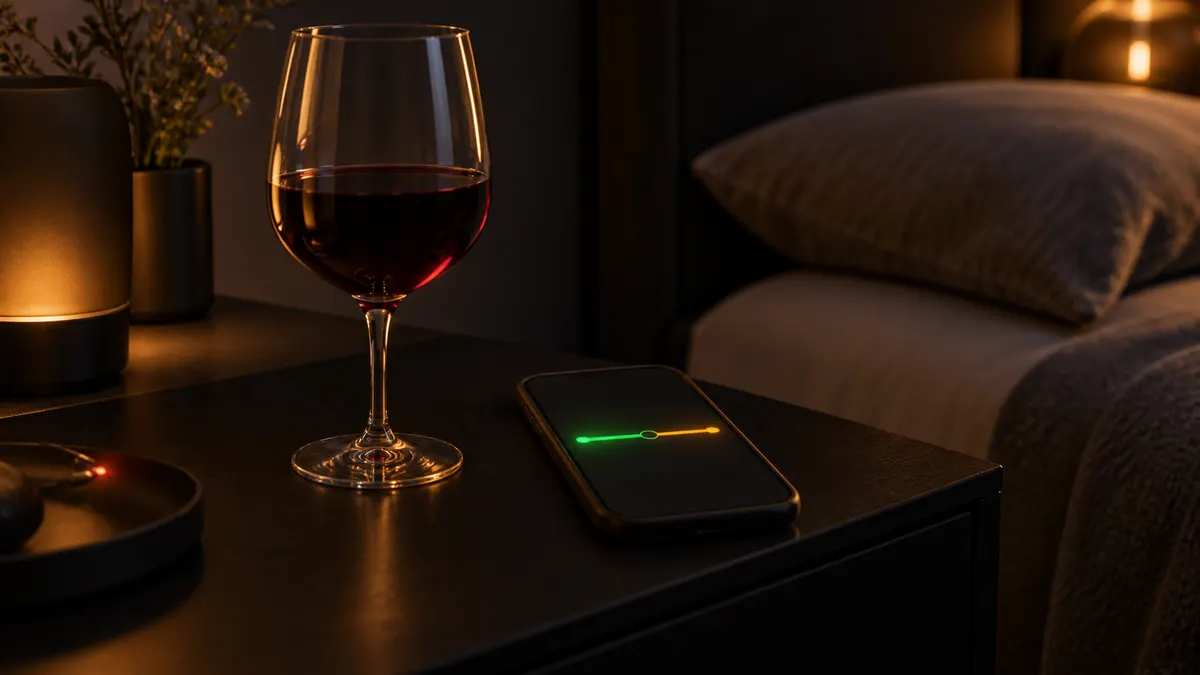
Alcohol makes you snore because it switches off the muscle that holds your tongue forward, and the effect is strongest in the first two hours after the last drink. Pooled across 13 sleep-lab studies with 279 patients, drinking before bed added about 4 breathing events per hour and lowered the lowest overnight oxygen reading by 2.7 points (Burgos-Sanchez et al. 2020). The liver clears roughly one standard drink an hour, which is where the "stop three hours before bed" rule comes from. Seven recorded nights show what it does to your snoring.
- In 12 awake volunteers, 1 ml of alcohol per kg of body weight significantly reduced activity in the genioglossus, the muscle that pulls the tongue forward, while breathing did not change (Krol et al. 1984).
- In 6 healthy male snorers, 0.79 g/kg at bedtime (about five standard drinks for an 80 kg man) raised the air pressure needed to silence snoring from 4.8 to 6.2 cm H2O, strongest in the first 2 hours (Mitler et al. 1988).
- In 21 habitual snorers, 0.5 g/kg drunk 90 minutes before bed, blood alcohol 0.07 g/dL, raised the breathing-event index from 7.1 to 9.7 per hour (Scanlan et al. 2000).
- Across 14 randomized trials with 422 people, alcohol raised the breathing-event index by 2.3 per hour overall, 4.2 in snorers and 7.1 in people with sleep apnea (Kolla et al. 2018).
- The liver oxidises about 7 g of alcohol an hour, roughly one drink, with a 3- to 4-fold spread between people (Cederbaum 2012).
This article is part of a series on snoring triggers you can check with a recorder, alongside sleeping position. The numbers come from published sleep-lab studies. We have no Snorly data on alcohol nights yet; when enough users have tagged them, we will add what those nights show.
Why do I snore when I drink?
Two things happen at once. First, alcohol quiets the genioglossus, the muscle under your tongue that keeps it from sliding backward. Krol's group measured it in awake volunteers: after 1 ml/kg the muscle's electrical activity fell significantly while the chest muscles carried on as normal. Asleep and on your back, a slack tongue narrows the airway behind it, and the soft palate flutters as air is pulled through the gap.
Second, alcohol raises the arousal threshold. Normally a partly blocked airway wakes you a fraction, you tense the muscles, the airway opens. After drinking that rescue comes later, so each narrowing lasts longer and gets louder. Issa and Sullivan saw both effects in seven patients in 1982: more and longer obstructions in the five with sleep apnea, and outright apnea in the first hour of sleep in the two who had only ever snored.
Does alcohol cause snoring in people who never snore?
At high doses, yes. Taasan's placebo-controlled study gave 20 healthy men 2 ml/kg of alcohol on one night and a placebo on the other. Breathing events across the group rose from 207 to 383 and apneas from 20 to 110, and oxygen desaturations stayed raised on the next, alcohol-free night (Taasan et al. 1981). In people who already snore the dose needed is smaller.
| CPAP pressure (cm H2O) | Placebo | 0.79 g/kg alcohol | Change |
|---|---|---|---|
| Pressure to stop snoring | 4.8 | 6.2 | 29% |
The CPAP number is the cleanest measure of what alcohol does to a snorer's throat: a machine had to push about 30% harder to keep the airway open, at a dose most people would call a heavy night.
How much alcohol does it take?
Less than a heavy night. Scanlan's group gave 21 habitual snorers 0.5 g/kg, about three standard drinks for an 80 kg man, 90 minutes before lights out. Blood alcohol at bedtime was 0.07 g/dL, just under the US driving limit. The breathing-event index rose from 7.1 to 9.7 per hour. Snoring loudness did not change significantly, which is why the count of events matters more than the volume in your own test.
| Events per hour (AHI) | No alcohol | 0.5 g/kg alcohol | Change |
|---|---|---|---|
| Apnea-hypopnea index | 7.1 | 9.7 | 37% |
The meta-analyses add the gradient: 2.3 extra events per hour in everyone, 4.2 in snorers, 7.1 in people with sleep apnea (Kolla et al. 2018). The more your airway already narrows, the more each drink costs you.
| Study | Who | Dose | Result |
|---|---|---|---|
| Krol 1984 | 12 awake volunteers | 1 ml/kg | Tongue-muscle activity significantly reduced |
| Scanlan 2000 | 21 habitual snorers | 0.5 g/kg, 90 min before bed | AHI 7.1 to 9.7 per hour |
| Mitler 1988 | 6 healthy snorers | 0.79 g/kg at bedtime | Apnea index 3.8 to 7.5; strongest in first 2 hours |
| Taasan 1981 | 20 healthy men | 2 ml/kg | Apneas 20 to 110 across the group |
| Kolla 2018 | 422 people, 14 trials | Various | AHI +2.3 overall, +4.2 in snorers, +7.1 in apnea |
How many hours before bed should I stop drinking?
Three hours is the number the Sleep Foundation gives, and the arithmetic behind it is simple. The liver oxidises about 7 g of alcohol an hour, one US standard drink, though the rate varies three- to fourfold between people and is faster after a meal (Cederbaum 2012). Two drinks are therefore mostly gone after two to three hours. Mitler's lab data agree: airway resistance was highest in the first two hours after the dose, then faded as blood alcohol fell.
The Sleep Foundation states the rule as "at least three hours before bedtime". No trial has compared a drink at one hour before bed with the same drink at three, so treat the rule as a starting point and let your recordings set your own number. Four drinks need more than three hours; one glass at dinner may need none.
How to test it in 7 nights
Record every night with the phone in the same spot, 0.5 to 1 m from your head, and change only the drinking. Three dry nights give you a range; three drinking nights show whether it moved; the seventh tests the timing rule.
| Night | Alcohol | Rules |
|---|---|---|
| 1 to 3 | None | Same bedtime within 30 minutes, usual pillow and position, record all night |
| 4 to 6 | 2 standard drinks, finished within the hour before bed | Same rules; same drink each night |
| 7 | 2 standard drinks, finished 3 hours before bed | Same rules; shows whether timing alone fixes it |
Compare snore minutes on the timeline, the number of clips and the loudness label of the loudest clip. In Snorly, tag nights 4 to 7 with "alcohol" as a factor and the app puts tagged nights next to untagged ones. Expect the count and minutes to move before the loudness does; that is what Scanlan's lab found.
Rule for calling it: if every drinking night has more snore minutes than your loudest dry night, alcohol is a lever for you. If night 7 lands back inside the dry range, timing is enough; if not, the number of drinks is the problem. The other levers are ranked in how to stop snoring; if the dry nights are loud too, start with why do I snore.
When alcohol unmasks sleep apnea
In some people alcohol turns snoring into pauses. Issa and Sullivan's two "benign" snorers stopped breathing repeatedly in the first hour after drinking, and across Kolla's trials the extra events were three times larger in people with apnea than in everyone else. A review of 21 population studies found heavier drinkers had a 25% higher risk of sleep apnea (Simou et al. 2018).
On a recording, look for snoring that stops for 10 seconds or more and restarts with a gasp, especially on the drinking nights. A phone can capture the gasp but cannot tell you whether your oxygen dropped, and no app can diagnose sleep apnea. If your alcohol nights show that pattern, snoring vs sleep apnea explains what a home sleep test involves.
- Put the phone on the nightstand, plugged in, and record a dry night. Baseline 1 of 3.
- Keep your usual bedtime and position so the only thing that changes later is the drink.
- If tonight is not dry, note the number of drinks and the time of the last one. That is a tagged night, not a wasted one.
- In the morning, listen to your loudest clip and note its loudness label.
Hear your own snoring tonightSnorly records only when it hears snoring and plays it back in the morning. Free, no account, no night limit.
Download on the App StoreRelated questions
Does alcohol make you snore?
Yes. It relaxes the muscle that holds the tongue forward and delays the reflex that reopens a narrowing airway. In sleep-lab trials a bedtime dose added about 4 breathing events per hour in snorers and made a CPAP machine push 30% harder.
How long after drinking do you snore?
The airway effect is strongest in the first two hours after the last drink and fades as the liver clears about one drink an hour. Two drinks finished three hours before bed are mostly gone by the time you sleep; four are not.
Does one glass of wine cause snoring?
For a habitual snorer it can, but the lab doses that moved the numbers were three drinks or more. Three dry nights against three one-glass nights will show your own threshold.
Is snoring after drinking a sign of sleep apnea?
Not by itself. Louder, longer snoring after alcohol is the normal muscle effect. Snoring that stops for 10 seconds or more and restarts with a gasp on alcohol nights is worth raising with a doctor, because alcohol can unmask apnea that is mild on dry nights.
Sources
- Krol RC, Knuth SL, Bartlett D Jr (1984). Selective reduction of genioglossal muscle activity by alcohol in normal human subjects. American Review of Respiratory Disease 129(2):247-250. https://pubmed.ncbi.nlm.nih.gov/6421210/
- Issa FG, Sullivan CE (1982). Alcohol, snoring and sleep apnea. Journal of Neurology, Neurosurgery and Psychiatry 45(4):353-359. https://doi.org/10.1136/jnnp.45.4.353
- Mitler MM, Dawson A, Henriksen SJ, Sobers M, Bloom FE (1988). Bedtime ethanol increases resistance of upper airways and produces sleep apneas in asymptomatic snorers. Alcoholism: Clinical and Experimental Research 12(6):801-805. https://doi.org/10.1111/j.1530-0277.1988.tb01349.x
- Scanlan MF, Roebuck T, Little PJ, Redman JR, Naughton MT (2000). Effect of moderate alcohol upon obstructive sleep apnoea. European Respiratory Journal 16(5):909-913. https://doi.org/10.1183/09031936.00.16590900
- Taasan VC, Block AJ, Boysen PG, Wynne JW (1981). Alcohol increases sleep apnea and oxygen desaturation in asymptomatic men. American Journal of Medicine 71(2):240-245. https://doi.org/10.1016/0002-9343(81)90124-8
- Burgos-Sanchez C, Jones NN, Avillion M, et al. (2020). Impact of Alcohol Consumption on Snoring and Sleep Apnea: A Systematic Review and Meta-analysis. Otolaryngology-Head and Neck Surgery 163(6):1078-1086. https://doi.org/10.1177/0194599820931087
- Kolla BP, Foroughi M, Saeidifard F, et al. (2018). The impact of alcohol on breathing parameters during sleep: A systematic review and meta-analysis. Sleep Medicine Reviews 42:59-67. https://doi.org/10.1016/j.smrv.2018.05.007
- Simou E, Britton J, Leonardi-Bee J (2018). Alcohol and the risk of sleep apnoea: a systematic review and meta-analysis. Sleep Medicine 42:38-46. https://doi.org/10.1016/j.sleep.2017.12.005
- Cederbaum AI (2012). Alcohol metabolism. Clinics in Liver Disease 16(4):667-685. https://pmc.ncbi.nlm.nih.gov/articles/PMC3484320/
- Sleep Foundation (accessed 2026). Alcohol and Sleep. https://www.sleepfoundation.org/nutrition/alcohol-and-sleep
Snorly is a snore recorder and tracker, not a medical device. It does not diagnose sleep apnea or any other condition. If you notice pauses in breathing, gasping or daytime sleepiness, talk to a doctor.