Which sleeping position stops snoring? Back vs side

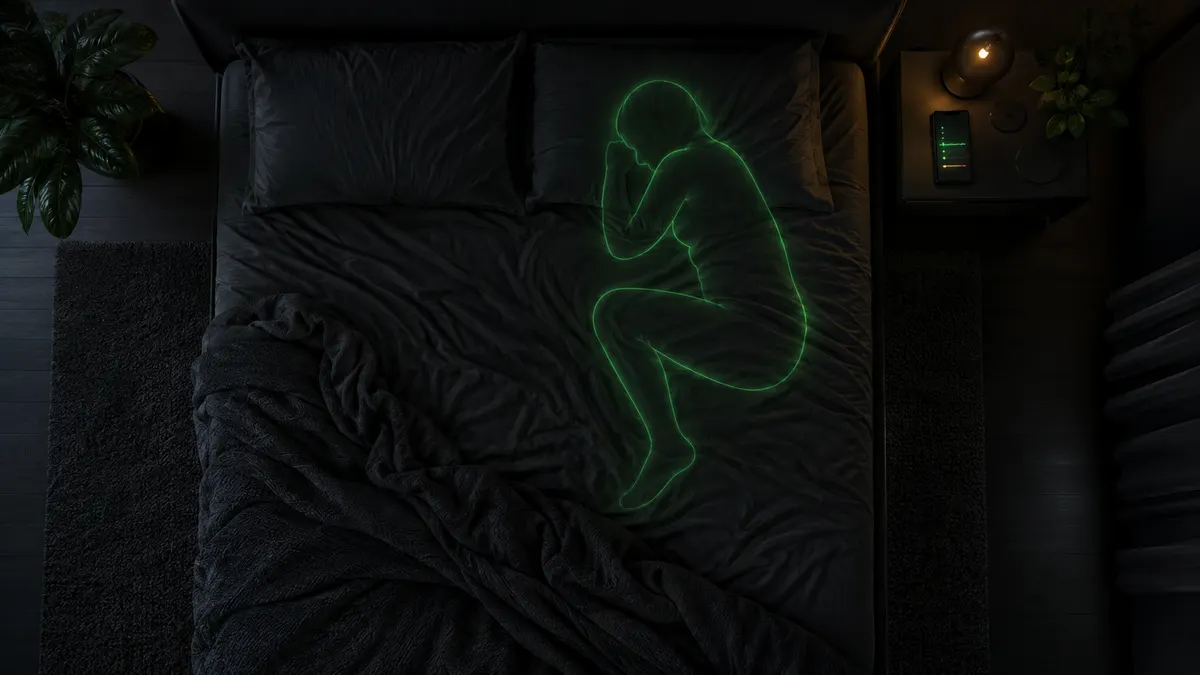
Side sleeping is the position that stops snoring for the largest group of people, and the effect is measurable. In the biggest sleep-lab series on the question, 55.9% of 574 patients had at least twice as many breathing events on their back as on their side (Oksenberg et al. 1997). Among snorers without sleep apnea, most snored for less time and more quietly on their side (Nakano et al. 2003). Seven recorded nights show whether you are one of them, and a full-night timeline shows the moment you roll over.
- Of 574 sleep-apnea patients, 55.9% had at least twice the breathing-event rate on their back as on their side; they were on average 6.5 kg lighter and 2 years younger (Oksenberg et al. 1997).
- In 72 habitual snorers, most non-apneic snorers snored less in time and intensity on their side; apnea patients often did not (Nakano et al. 2003).
- Two and a half years after being prescribed the tennis-ball technique, 4 of 67 patients (6%) still used it; 34 of the 54 who quit called it too uncomfortable (Bignold et al. 2009).
- A chest-worn trainer that vibrates when you roll onto your back cut back-sleeping time from 49.9% to 0% of the night and the breathing-event index from 16.4 to 5.2 per hour in one month (van Maanen et al. 2013).
- Raising the head of the bed 7.5 degrees lowered the breathing-event index from 15.7 to 10.7 per hour in 52 patients (Souza et al. 2017).
This article is part of a series on remedies you can check with a recorder instead of a review, alongside the anti-snoring pillow and alcohol timing. The numbers come from published sleep-lab studies. We have no Snorly data on sleeping position yet; when enough users have tagged back-sleeping nights, we will add what those nights show.
Why do I snore when I sleep on my back?
Because gravity works against your airway. On your back, the tongue and soft palate sink toward the back of the throat and the airway behind the tongue narrows. Each breath pulls air through a smaller gap, the tissue flutters, and that flutter is the snore. On your side the tongue falls sideways instead of backward, so the gap stays wider with no effort from you.
Oksenberg's group counted a patient as positional when the breathing-event rate on the back was at least twice the rate on the side, and 55.9% of 574 met that bar. They were thinner, younger and milder. In heavy, severe cases position mattered less, because the airway was narrow in every posture.
Does sleeping on your side really stop snoring?
For most snorers without sleep apnea, yes, by a measured amount. Nakano's team compared each person's back and side sleep on the same night in 72 habitual snorers. In the non-apneic snorers, snoring time and intensity both fell on the side (p = 0.0004 and 0.0003). In the apnea group the result was mixed: people with a high back-sleeping event rate often kept snoring on their side.
That split is the useful part. If side sleeping fixes your recording, position was your cause. If four side nights sound the same as three back nights, the cause is elsewhere, and the decision tree in why do I snore is the next stop.
How to sleep on your side and stay there
Falling asleep on your side is easy. Staying there at 3 a.m. is the problem, and the trials measured exactly that.
The tennis-ball technique, a ball pinned to the back of a T-shirt, works on the nights you wear it. Bignold's team surveyed 67 patients two and a half years after prescribing it: 4 still used it, 9 had learned to avoid their back without it, and 54 had gone back to sleeping however they slept, 34 of them because the ball was too uncomfortable.
Vibrating positional trainers were built to fix that. A small device strapped to the chest buzzes when you roll onto your back until you turn.
| Events per hour (AHI) | Baseline | With trainer | Change |
|---|---|---|---|
| Apnea-hypopnea index | 16.4 | 5.2 | -68% |
Time on the back went from 49.9% of the night to 0%, with 92.7% compliance. Head to head, trainer and tennis ball kept people off their back equally well, but the trainer was used properly (4 hours a night, 5 nights a week) by 75.9% of patients against 42.3% for the ball (Eijsvogel et al. 2015).
| Method | What it does | Evidence | Weak point |
|---|---|---|---|
| Tennis ball or backpack | Makes back sleeping uncomfortable | Works while worn; 6% still using it after 2.5 years (Bignold 2009) | Comfort |
| Body or side-sleeping pillow | Blocks the roll | See the pillow article | Easy to push away |
| Vibrating trainer | Buzzes until you turn | AHI 16.4 to 5.2 in a month; 92.7% compliance (van Maanen 2013) | Price, a chest strap |
| Head-of-bed elevation | Gravity pulls less on the tongue | AHI 15.7 to 10.7 at 7.5 degrees (Souza 2017) | Does not stop the roll |
Does raising the head of the bed help?
It helps some, without changing which side you sleep on. Souza's group ran 52 sleep-apnea patients through a baseline night and a night with the whole bed tilted 7.5 degrees at the head. The breathing-event index fell by about a third and the lowest oxygen reading rose from 83.5% to 87%.
| Events per hour (AHI) | Bed flat | Head raised | Change |
|---|---|---|---|
| Apnea-hypopnea index | 15.7 | 10.7 | -32% |
Elevation is the fallback for people whose shoulder or hip rules out side sleeping. Stacking pillows is not the same thing: it bends the neck instead of tilting the body. Tilt the bed or use a long wedge.
How a full-night timeline shows a roll-over
A positional snorer has a recognisable night. The first half is quiet, because most people fall asleep on their side. Around the middle of the night the recording gets loud and stays loud, because they rolled onto their back and stayed there. On a timeline that is a flat line turning into a wall of clips after 2 or 3 a.m.
In Snorly the timeline marks every snoring clip against the clock, so you can see the hour it started and match it to the position you woke up in. A night that is loud from the first hour points away from position and toward the nose, the mouth or a late drink. A phone recording cannot tell you which position you were in, so note it in the morning.
How to test side sleeping in 7 nights
Record every night with the phone in the same spot, 0.5 to 1 m from your head, and change only your position. Three baseline nights give you a range; four side nights show whether the range moved.
| Night | Position | Rules |
|---|---|---|
| 1 to 3 | However you normally sleep | Same bedtime within 30 minutes, no alcohol, note the position you woke up in |
| 4 to 7 | Side, held there | Tennis ball in a sock pinned to the back of a T-shirt, or a body pillow behind you; note any night you woke on your back |
Compare snore minutes, clip count and the loudness label of the loudest clip. In Snorly, tag nights 1 to 3 with "back sleeping" as a factor and the app lines them up against the untagged nights.
Rule for calling it: if every side night has fewer snore minutes than your quietest baseline night, position is your lever, and the only question left is which method you will still be using in a month. If the ranges overlap, see the ranking of fixes in how to stop snoring.
- Put the phone on the nightstand, plugged in, and record a night in your usual position. Baseline 1 of 3.
- Skip alcohol; it relaxes the airway in every position and would blur the comparison.
- In the morning, note the position you woke up in next to the night's score.
- Look at the timeline for a quiet first half and a loud second half. That is the roll-over.
Hear your own snoring tonightSnorly records only when it hears snoring and plays it back in the morning. Free, no account, no night limit.
Download on the App StoreRelated questions
What is the best sleeping position for snoring?
On your side, for most people. In the largest sleep-lab series, 55.9% of 574 patients breathed at least twice as badly on their back, and most snorers without apnea snored less on their side. Stomach sleeping keeps the tongue forward too but strains the neck.
Why do I snore on my back but not on my side?
Gravity. On your back the tongue and soft palate drop toward the back of the throat and narrow the airway; on your side they fall sideways. This is positional snoring, the most fixable kind.
Does a tennis ball really work for snoring?
Yes on the nights you wear it, and it is the cheapest test of whether position is your cause. Only 6% of patients were still using it after two and a half years. Use it for the 4 test nights, then pick a method you can live with.
Can side sleeping stop sleep apnea?
It can reduce mild positional apnea, as the trainer trials showed, but apnea patients often kept snoring on their side, and no app can diagnose apnea. Snoring with 10-second silences and gasps is a reason for a sleep test, see snoring vs sleep apnea.
Sources
- Oksenberg A, Silverberg DS, Arons E, Radwan H (1997). Positional vs Nonpositional Obstructive Sleep Apnea Patients. Chest 112(3):629-639. https://doi.org/10.1378/chest.112.3.629
- Nakano H, Ikeda T, Hayashi M, Ohshima E, Onizuka A (2003). Effects of body position on snoring in apneic and nonapneic snorers. Sleep 26(2):169-172. https://doi.org/10.1093/sleep/26.2.169
- Bignold JJ, Deans-Costi G, Goldsworthy MR, et al. (2009). Poor long-term patient compliance with the tennis ball technique for treating positional obstructive sleep apnea. Journal of Clinical Sleep Medicine 5(5):428-430. https://pmc.ncbi.nlm.nih.gov/articles/PMC2762713/
- van Maanen JP, Meester KA, Dun LN, et al. (2013). The sleep position trainer: a new treatment for positional obstructive sleep apnoea. Sleep and Breathing 17(2):771-779. https://doi.org/10.1007/s11325-012-0764-5
- Eijsvogel MM, Ubbink R, Dekker J, et al. (2015). Sleep position trainer versus tennis ball technique in positional obstructive sleep apnea syndrome. Journal of Clinical Sleep Medicine 11(2):139-147. https://doi.org/10.5664/jcsm.4460
- Souza FJFB, Genta PR, de Souza Filho AJ, Wellman A, Lorenzi-Filho G (2017). The influence of head-of-bed elevation in patients with obstructive sleep apnea. Sleep and Breathing 21(4):815-820. https://doi.org/10.1007/s11325-017-1524-3
- Sleep Foundation (accessed 2026). Snoring: Causes, Risks, and Treatments. https://www.sleepfoundation.org/snoring
Snorly is a snore recorder and tracker, not a medical device. It does not diagnose sleep apnea or any other condition. If you notice pauses in breathing, gasping or daytime sleepiness, talk to a doctor.