How to tell if you snore when you sleep alone

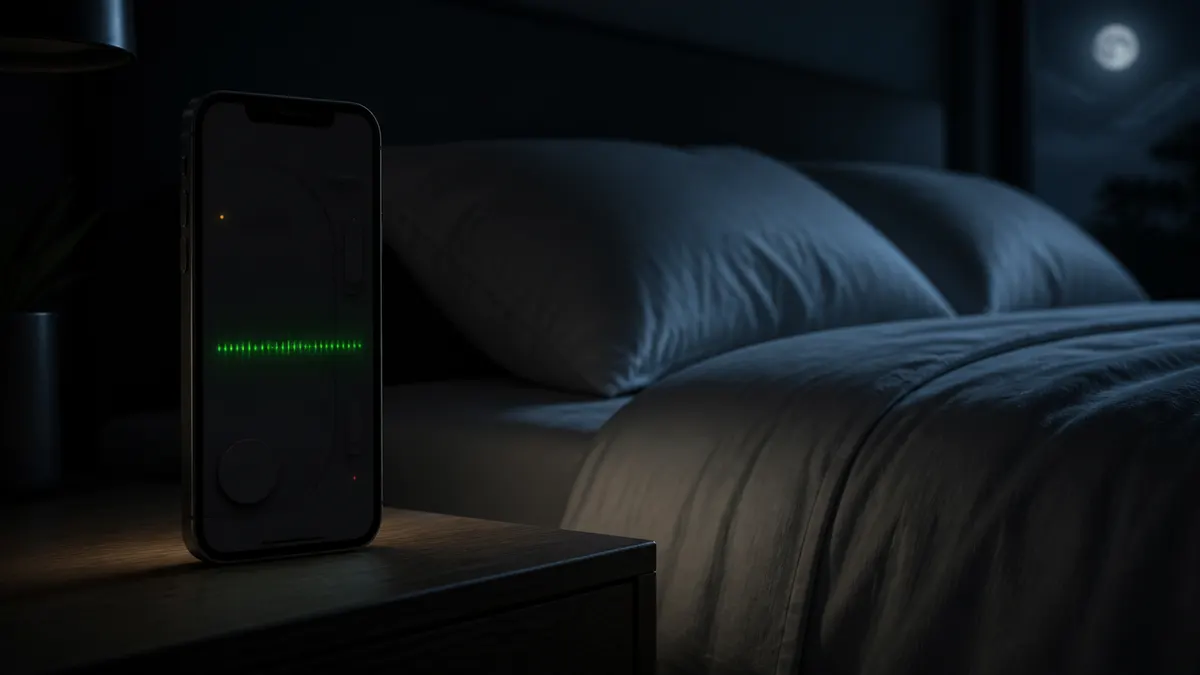
The reliable way to tell if you snore is to record yourself for three nights and listen to the clips in the morning. Morning signs help, a dry mouth, a sore throat, waking up tired, but each of them has other causes. The odds are not in your favor either: Cleveland Clinic estimates that about 45% of adults snore sometimes and 25% snore regularly. Three recordings settle the question inside a week, with nobody else in the room.
- About 45% of adults snore occasionally and 25% snore regularly (Cleveland Clinic).
- Snoring changes with alcohol, nasal congestion and sleep position, so one quiet night proves little; Mayo Clinic lists all three as causes.
- A phone 0.5 to 1 m from your head, face down on the nightstand and on the charger, picks up snoring clearly without a special microphone (our setup).
- A night needs at least 4 hours of recording before the app rates it; shorter sessions are marked "Too short" (our data).
Can you tell if you snore without anyone telling you?
Yes, but not by lying there and listening. You are asleep when it happens, and the sound stops the moment you wake up enough to notice it. What people report as "I heard myself snore" is usually the last snort of an episode, caught in light sleep.
So the check has to happen while you are not there, which means a recording. A partner can tell you that you snore, but not how often, how loud or at what time of night. A recording gives you all three, with nobody's opinion attached.
What are the morning signs that you snore?
A dry mouth, a sore throat and a headache on waking are the classic hints, and Mayo Clinic lists all of them among the symptoms that go with snoring. None of them proves it. The table shows what else causes each sign, which is why they are a reason to record, not a verdict.
| Morning sign | Snoring link | Other common causes |
|---|---|---|
| Dry mouth, cracked lips | Mouth-open breathing all night | Dry bedroom air, some medications |
| Sore or scratchy throat | Hours of airway vibration | Cold, allergies, reflux |
| Morning headache | Fragmented sleep, low oxygen in apnea | Caffeine withdrawal, teeth grinding |
| Waking up unrefreshed | Repeated micro-arousals | Too little sleep, stress, alcohol |
| Waking yourself with a snort | Your own snore or a breathing pause | Falling-asleep jerk |
| Daytime sleepiness | Fragmented sleep | Short sleep, shift work, low iron |
Two or more of these on most mornings is a reason to record the next three nights. None of them is still a reason to record. Plenty of people snore without a single symptom they can feel.
How do you record yourself snoring for the 3-night test?
Put your phone on the nightstand, 0.5 to 1 m from your pillow, face down, plugged in, with Do Not Disturb on. Keep it off the mattress, where the blanket muffles it, and away from a fan or open window. Then change nothing about your evening. The test measures a normal night, not a rehearsed one.
Voice Memos works for one night, but you end up with an 8-hour file to scrub through. A snore app records only when it hears snoring, so the morning is a handful of clips instead of a silent timeline. Snorly does this on the phone, keeps the audio on the phone, and labels each clip Quiet, Light, Moderate or Severe; it is free to try for one night with no account. The full setup, including a Voice Memos comparison, is in how to record yourself snoring on iPhone.
Three nights, not one, because your snoring on a Friday after two beers and your snoring on a Tuesday with a blocked nose are different animals. Tag each night with what happened: alcohol, late meal, back sleeping, congestion. The tags are what make the third morning readable.
How do you read the result?
Listen to the clips before you look at any score. Your ear will tell you within ten seconds whether that was you snoring, coughing, talking in your sleep or a truck outside. Then use the summary to answer "how much".
| What three nights show | What it means | Next step |
|---|---|---|
| No snore clips, but the timeline shows room noise or a cough | Probably not a regular snorer | Recheck after a cold or a heavy evening |
| No clips and a flat timeline | The mic did not hear the room | Move the phone closer, off the mattress, try again |
| A few Light clips on one night only | Occasional snoring with a trigger | That night's tag is your suspect |
| Snoring on all three nights, Light to Moderate | Habitual snoring | Work through the causes in why do I snore |
| Moderate to Severe every night, a quarter of the night or more | Loud, habitual snoring | Worth a plan and, if there are pauses, a professional |
| Any clip with silence followed by a gasp or snort | A breathing pattern worth discussing with a professional | Read snoring vs sleep apnea |
The nightly score runs 0 to 100, higher is better, and 100 means no snoring was detected. The bands are Excellent (90 and up), Good (70 to 89), Average (50 to 69), Poor (30 to 49) and Very poor below 30. As a reference, moderate snoring through about 10% of the night scores around 74, and through a quarter of the night around 53. The formula is on the snore score page.
Does snoring mean you have sleep apnea?
No. Most people who snore do not have sleep apnea, and the recording cannot decide it either way. The signs NHLBI lists as worth acting on are loud snoring with pauses in breathing, gasping or choking during sleep, and daytime sleepiness that does not match how long you slept.
A phone recording can catch the pauses and the gasp. It cannot tell you whether your oxygen dropped, which is what a sleep study measures. If your clips show the snore, silence, gasp pattern, take them to a doctor. That is the one case where the audio is worth more than any questionnaire.
What if the recording is quiet but you still wake up tired?
Then snoring is probably not your problem, and that is useful to know. Short sleep, an irregular schedule, alcohol and reflux all produce the same tired mornings. The Epworth Sleepiness Scale, eight questions scored 0 to 24, is the standard way to put a number on daytime sleepiness; above 10 is the usual threshold for "too sleepy".
- Put the phone face down on the nightstand, 0.5 to 1 m from your pillow, on the charger, Do Not Disturb on.
- Start a snore app or Voice Memos before lights out and leave the room as it usually is, fan included if you always use one.
- Write down tonight's tags before you sleep: alcohol, late meal, congestion, back or side.
- In the morning, listen to the clips before looking at any score, then note how many, how loud, and when.
- Repeat for two more nights before you decide anything.
Hear your own snoring tonightSnorly records only when it hears snoring and plays it back in the morning. Free, no account, no night limit.
Download on the App StoreRelated questions
How can I tell if I snore if I sleep alone?
Record yourself. A phone on the nightstand with a snore-triggered app, or Voice Memos for one night, is enough. Three recorded nights, tagged for alcohol, congestion and position, answer the question and show what makes it worse.
Do healthy people snore?
Yes. Cleveland Clinic puts occasional snoring at around 45% of adults, most of them otherwise healthy. The pattern to take seriously is loud snoring every night with pauses, gasping or daytime sleepiness, which NHLBI lists as signs of sleep apnea.
How do I check if I snore without an app?
Use Voice Memos for one night, then scrub the file in the morning at 2x speed, watching the waveform for repeating bursts every 3 to 5 seconds. It works, but an 8-hour file is tedious to review, which is why snore-triggered apps exist.
Is snoring every night normal?
Common is not the same as harmless. Nightly snoring means something narrows your airway consistently: your nose, your sleep position, your weight or your evening habits. It is worth finding the cause. If it is also loud, or someone notices pauses, talk to a doctor.
Why do I hear myself snore?
You are catching the tail of an episode in light sleep, usually as you drift off or near waking. The snort that wakes you can be your own snore or, sometimes, the end of a breathing pause. If it happens often, a recording will show which.
Sources
- Cleveland Clinic (2026). Snoring. https://my.clevelandclinic.org/health/diseases/15580-snoring
- Mayo Clinic. Snoring: Symptoms and causes. https://www.mayoclinic.org/diseases-conditions/snoring/symptoms-causes/syc-20377694
- Mayo Clinic. Snoring: Diagnosis and treatment. https://www.mayoclinic.org/diseases-conditions/snoring/diagnosis-treatment/drc-20377701
- National Heart, Lung, and Blood Institute. Sleep apnea: Symptoms. https://www.nhlbi.nih.gov/health/sleep-apnea/symptoms
- Johns MW (1991). A new method for measuring daytime sleepiness: the Epworth Sleepiness Scale. Sleep 14(6). https://pubmed.ncbi.nlm.nih.gov/1798888/
- American Academy of Sleep Medicine, Sleep Education. Snoring. https://sleepeducation.org/sleep-disorders/snoring/
Snorly is a snore recorder and tracker, not a medical device. It does not diagnose sleep apnea or any other condition. If you notice pauses in breathing, gasping or daytime sleepiness, talk to a doctor.