What does snoring sound like? Decibels and types

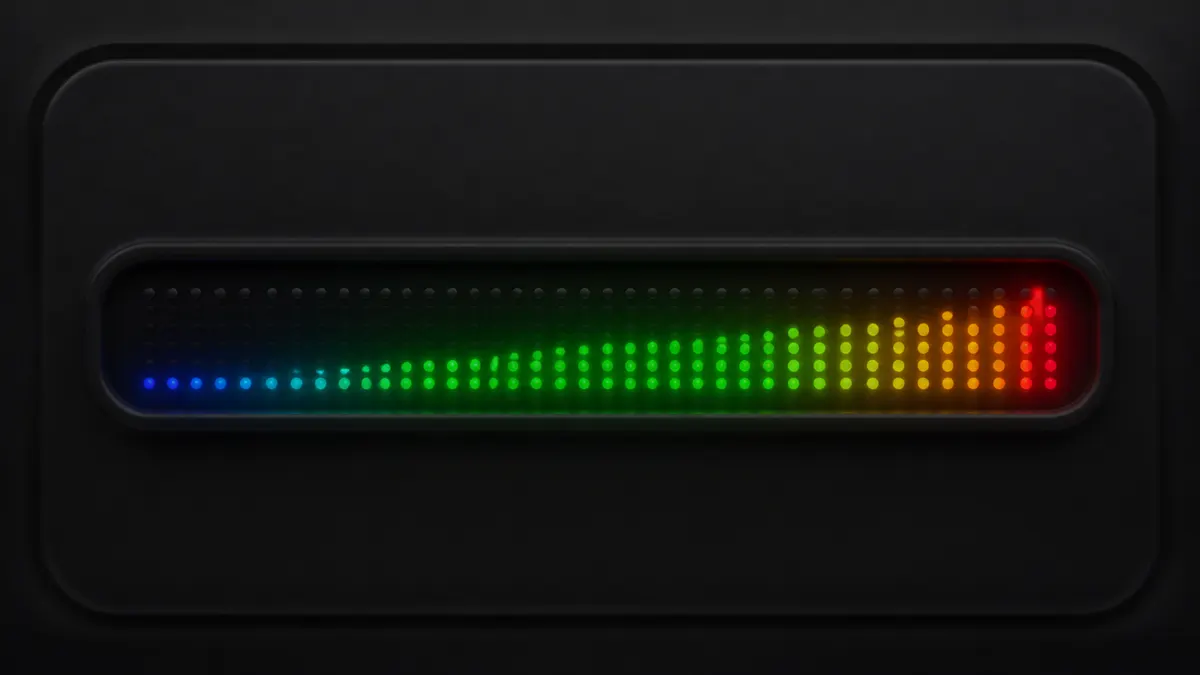
Snoring sounds like a low, rattling vibration on the in-breath, one burst every 3 to 5 seconds, with a quieter out-breath between. Quiet snoring is a soft purr around the level of a refrigerator hum. Loud snoring commonly runs 50 to 90 dB at the bedside, the range between normal conversation and a gas lawn mower, and the Guinness record stands at 111.6 dB. The exact sound depends on where in the airway it comes from, and that is something you can hear on a recording.
- Normal breathing is about 10 dB, a whisper 30 dB, a refrigerator hum 40 dB, normal conversation 60 dB, a washing machine 70 dB (CDC noise chart).
- Loud snoring commonly measures 50 to 90 dB near the sleeper; the loudest on record is 111.6 dB, Jenny Chapman, UK, 2009 (Guinness World Records).
- Sound drops about 6 dB each time distance doubles, so a phone at 1 m hears a snore roughly 10 dB quieter than a partner's ear at 30 cm (inverse-square law).
- Adults at rest breathe 12 to 20 times a minute, which is why snores arrive every 3 to 5 seconds (standard respiratory rate).
- A snore app's Quiet, Light, Moderate and Severe labels are a relative loudness scale from the phone's microphone, not a calibrated dB meter (our data).
- In the recorded apnea example below, snoring stops for 32 seconds before it resumes; a pause of 10 seconds or more is the threshold used in sleep medicine (Ziegler et al. 2011; AASM scoring rules).
What does snoring actually sound like?
Four real recordings, not sound effects. The first three are cut from one 8-hour night recorded by a single sleeper on one microphone, with the same gain applied to each, so the difference in loudness between them is the difference that was in the room. Headphones help for the first one.
Light snoring. A soft purr on the in-breath, one every 5 seconds, barely above the room's noise floor. This is the "you were making a little noise" level a partner mentions once and forgets.
Moderate snoring. The same sleeper an hour earlier. The rattle is clear, the rhythm is steady at one snore every 4 to 5 seconds, and it would carry through a closed door. This is where most complaints start.
Severe snoring. About 10 dB louder than the light clip, roughly twice as loud to the ear, with a harder edge on each in-breath. On a phone timeline this is the top loudness band.
Snoring with a breathing pause. From a different sleeper, published with a medical paper. Strong rhythmic snoring for 8 seconds, then 32 seconds of near silence, then snoring resumes. That silence, not the volume, is the part a doctor wants to hear about; the pattern is explained at the end of this article.
Light, moderate and severe: excerpts from "Person sleeping" by Wilfredor, Wikimedia Commons, 2023, CC0. Breathing pause: Ziegler et al., "Effectively incorporating selected multimedia content into medical publications", BMC Medicine 9:17, 2011, CC BY 2.0, via Wikimedia Commons.
Listen for three things. The rhythm: one burst per breath, so a steady snorer produces one every 3 to 5 seconds. The texture: a rattle or flutter rather than a tone, because loose tissue is vibrating, not air whistling through a gap. And the shape: many snores start soft and grow over several breaths as the airway relaxes. Snoring that builds, cuts to silence, then breaks with a snort is a different pattern, covered at the end.
For comparison, this is what a clip from the app itself sounds like, a typical moderate snore recorded from a nightstand:
4-second demo clip from Snorly
How loud is snoring in decibels?
Most snoring lands between a refrigerator hum and a vacuum cleaner. The table uses the CDC's everyday reference levels, with snoring placed where clinic measurements usually put it.
| Level | Everyday equivalent (CDC) | Snoring at this level |
|---|---|---|
| 10 dB | Normal breathing | Silent sleep |
| 30 dB | Soft whisper | Faint mouth breathing |
| 40 dB | Refrigerator hum | Quiet snoring; audible in a silent room |
| 50 dB | Moderate rainfall | Light snoring; where "loud" begins |
| 60 dB | Normal conversation | Moderate snoring; heard through a closed door |
| 70 dB | Washing machine, dishwasher | Loud snoring; disturbs a partner nightly |
| 80 to 85 dB | Traffic from inside a car, gas lawn mower | Very loud; heard in the next room |
| 90 dB and up | Leaf blower and louder | Rare; the 111.6 dB record is siren territory |
Decibels are logarithmic: a 10 dB step sounds roughly twice as loud, so a 70 dB snorer is about four times louder to the ear than a 50 dB one.
Is 40 dB snoring loud?
No. 40 dB is a refrigerator in a quiet kitchen. In a bedroom with the window shut it is audible, but barely above the room's own noise floor, and most people would call it purring. It becomes a problem only for a light sleeper lying 30 cm away.
Distance is the catch with any number a phone gives you. A snore that reads 40 dB on a phone 1 m from your head reaches a partner's ear at about 50 dB, because sound gains roughly 6 dB each time the distance halves. If your app says 40 and your partner says "loud", you are both right.
What do the four loudness bands in a snore app mean?
Quiet, Light, Moderate and Severe are the four bands Snorly puts on each clip, and they are relative, not absolute. A phone microphone with no calibration and no fixed distance cannot measure dB SPL the way a sound meter does, so the app maps the signal it receives onto a fixed scale and cuts it into four zones. Quiet is background noise, Light the soft purr, Moderate what a partner would complain about, Severe the top of the scale.
The bands feed the nightly score, 0 to 100 where 100 means no snoring, with Severe minutes counting more than Light ones. They are good for one thing: comparing your own nights. Keep the phone in the same spot and Tuesday's Severe means the same as Friday's; move it and the labels shift. The formula is on the snore score page.
Nasal snoring vs mouth snoring: how do they sound?
Where the vibration happens changes the pitch, and you can usually hear it on a clip. The British Snoring and Sleep Apnoea Association sorts snorers into nose, mouth and tongue types with simple self-tests, and the sounds line up with those types.
| Type | Where it vibrates | What it sounds like | Usually worse when |
|---|---|---|---|
| Nasal | Nostrils, nasal passages | Higher, thinner, whistling or "ratty"; mouth closed | Cold, allergies, deviated septum |
| Palatal (mouth) | Soft palate and uvula | Low, flapping rumble, the cartoon snore; mouth open | Alcohol, back sleeping, dry mouth |
| Tongue-based | Base of the tongue against the throat | Deep, throaty, sometimes choking; irregular | Flat on the back, sedatives, heavier neck |
Most people mix two. A blocked nose forces the mouth open, so a nasal snorer produces palatal noise as well, and rolling onto the back brings the tongue in. That is why one person's snoring changes across a night. The cause-by-cause walk-through is in why do I snore.
Why do you snore with your mouth closed?
Because the sound is either coming through your nose or from your soft palate vibrating against the back of your tongue. Closed-mouth snoring is usually higher pitched and is the pattern most often tied to a narrow or congested nose. Try it awake: close your mouth and breathe in hard through your nose. If you can make a snoring noise that way, your nose is narrow enough to do it asleep.
It is also the snoring that nasal strips, dilators and treating congestion help most, because they open the exact passage making the noise. Test it: one night with a strip, one without, same phone position, compare the clips.
Which snoring sounds are worth a professional's ear?
The one to listen for is not loudness but silence. Snoring that builds over several breaths, stops completely for ten seconds or more, then restarts with a gasp, a snort or a choking sound is the pattern NHLBI describes for obstructive sleep apnea. Steady snoring, even loud steady snoring, is a different sound.
The fourth clip at the top of this article is exactly that sequence: 8 seconds of snoring, 32 seconds of silence, snoring again. A phone recording captures it clearly, and that alone is worth taking to a doctor. It cannot tell you whether your oxygen dropped during the silence, which is what a sleep study measures and what apps cannot diagnose. The two patterns are compared minute by minute in snoring vs sleep apnea.
- Put the phone face down on the nightstand, 0.5 to 1 m from your pillow, and leave it in that exact spot every night so loudness labels stay comparable.
- Record with a snore-triggered app or Voice Memos, Do Not Disturb on, fan or window as usual.
- In the morning, play the loudest clip and note the pitch: thin and whistling means nose, low rumble means palate, throaty means tongue.
- Any clip where the snoring stops for ten seconds and returns with a gasp gets saved for a doctor.
Hear your own snoring tonightSnorly records only when it hears snoring and plays it back in the morning. Free, no account, no night limit.
Download on the App StoreRelated questions
What does sleep apnea sound like?
Snoring that grows louder over several breaths, stops into silence for ten seconds or more, then restarts with a gasp, snort or choking sound. The silence is the tell, not the volume. NHLBI lists loud snoring with pauses and gasping among the main signs; a recording can show the pattern, but only a sleep study can confirm apnea.
Why does my breathing sound like snoring when I am awake?
Noisy breathing while awake, especially through the nose, usually means a narrowed nasal passage: congestion, allergies, a deviated septum or swollen turbinates. It often predicts nasal snoring at night. If it is new, persistent or comes with wheezing, see a doctor rather than a snore app.
Can a phone measure snoring in decibels?
Only relatively. A phone microphone has no calibration and sits at an unknown distance, so its readings are not dB SPL. What it does well is compare one night with another when the phone stays in the same place. Treat app numbers as a scale for your own nights, not a sound meter.
Is loud snoring dangerous?
Loud snoring by itself is a nuisance, but it is the first STOP-BANG screening question because the loudest snorers are more likely to have sleep apnea. Loud plus pauses, gasping, morning headaches or daytime sleepiness is worth a doctor's visit. Loud and steady with none of those is a cause-finding project, not an emergency.
Sources
- Centers for Disease Control and Prevention. What noises cause hearing loss? https://www.cdc.gov/hearing-loss/causes/index.html
- Guinness World Records. Loudest snore. https://www.guinnessworldrecords.com/world-records/loudest-snoring
- National Heart, Lung, and Blood Institute. Sleep apnea: Symptoms. https://www.nhlbi.nih.gov/health/sleep-apnea/symptoms
- Mayo Clinic. Snoring: Symptoms and causes. https://www.mayoclinic.org/diseases-conditions/snoring/symptoms-causes/syc-20377694
- British Snoring and Sleep Apnoea Association. What kind of snorer are you? https://britishsnoring.co.uk/why_do_i_snore/what_kind_of_snorer_are_you.php
- Chung F et al. (2008). STOP questionnaire: a tool to screen patients for obstructive sleep apnea. Anesthesiology 108(5). http://www.stopbang.ca
Snorly is a snore recorder and tracker, not a medical device. It does not diagnose sleep apnea or any other condition. If you notice pauses in breathing, gasping or daytime sleepiness, talk to a doctor.