How to Sleep When Your Partner Snores (Without a Fight)

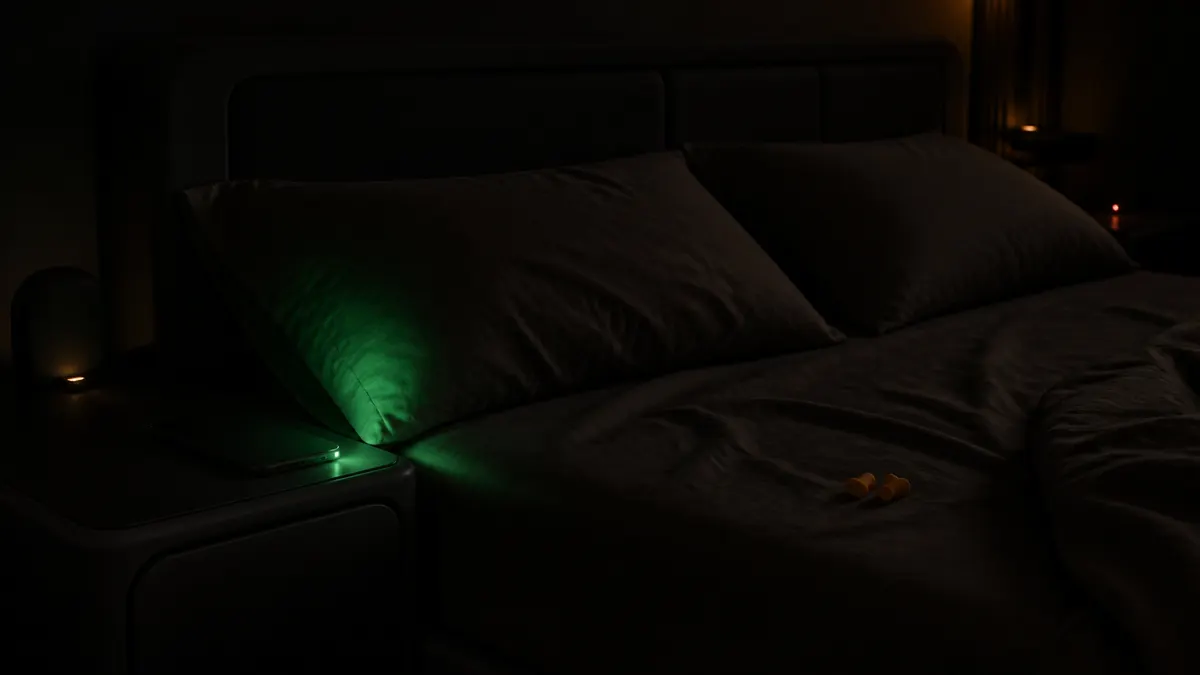
The fastest way to sleep next to a snorer is to stop arguing about whether they snore and get one recording. Play it back together in the morning, calmly, and the conversation moves from "you're exaggerating" to "what do we do about it". Then check the clip for pauses and gasps, because about 80% of people with sleep apnea have never been tested. Only after that do earplugs, white noise, side sleeping and a spare room come in.
- In a Mayo Clinic study of 10 couples, bed partners' sleep efficiency rose from about 74% to 87% once the snorer's breathing was treated mid-night with CPAP (Beninati 1999)
- 44% of men and 28% of women aged 30 to 60 snore regularly (Sleep Foundation)
- Foam earplugs labelled NRR 33 give about 13 dB of real-world reduction by OSHA's field formula, (NRR minus 7) divided by 2 (OSHA 1910.95 Appendix B)
- 35% of US adults occasionally or consistently sleep in another room to accommodate a bed partner (AASM survey of 2,005 adults, 2023)
Why does my partner not believe they snore?
Because they are asleep when it happens and awake when you complain. Snorers rarely hear themselves; the sound that wakes you is, to them, a story told at breakfast by a tired, irritated person.
A recording ends the argument. Put a phone on their side of the bed for one night, with their knowledge, and let a snore app save the clips. In the morning there is a 20-second clip labelled Severe with a time stamp. Houston Methodist's ENT advice for partners is to test like a scientist; the recording is the measurement. Setup is in how to record snoring on iPhone.
How do I bring up snoring without a fight?
Lead with the clip, not the complaint, and ask for a decision rather than an apology. Do it at breakfast or on a walk, never at 3 a.m. with the light on. Three lines that work:
- "I recorded last night because I wanted to know if I was being oversensitive. Listen to this one. What do you think?"
- "I'm not angry. I'm tired, and I'd rather fix this together than keep poking you in the ribs."
- "Can we try one thing for a week and record it, so we know if it helped instead of guessing?"
Say the number: "the app counted 47 minutes of snoring" is harder to dispute and easier to hear than "you kept me up all night". Make the recording the referee: three nights as they are, four nights with the change, compare.
Is my partner's snoring a sign of sleep apnea?
It might be, and this is the one step not to skip. Snoring itself is a noise problem; snoring with pauses is a breathing problem. Listen to the recording, and to your partner, for these:
- Silent gaps of 10 seconds or more, followed by a snort, gasp or choke
- Snoring loud enough to hear through a closed door, most nights
- Falling asleep in the day, while reading, driving or in front of the TV
- Morning headaches, a dry mouth, waking to urinate several times
- High blood pressure, a neck over 40 cm (about 16 inches), age over 50
The STOP-BANG questionnaire turns these into a score; 3 or more out of 8 is the point to ask a doctor about a home sleep apnea test. A phone recording cannot tell you whether their oxygen dropped; the clip is a reason to book a test, not a result. The full comparison is in snoring vs sleep apnea.
Do earplugs block snoring?
Partly. Earplugs reduce snoring; they do not remove it. The number on the box is the NRR, measured in a lab with a perfect fit. OSHA's formula for what you actually get is (NRR minus 7) divided by 2, so a foam plug rated 33 cuts roughly 13 dB in real use.
| Earplug type | Typical label | Real-world cut (OSHA formula) | Notes |
|---|---|---|---|
| Foam, roll-and-insert | NRR 29 to 33 | 11 to 13 dB | Cheapest, best reduction, can itch by morning |
| Moldable silicone | NRR 22 | about 8 dB | Sits over the canal; comfortable for side sleepers |
| Reusable flanged or "sleep" plugs | NRR 20 to 27 | 7 to 10 dB | Washable, quieter than foam, less isolation |
Thirteen dB turns a 60 dB snore, about conversation level, into something closer to a quiet office. It will not silence a 75 dB snorer. Sleep Foundation notes that in a small study of couples, earplugs improved how severe the partner perceived the snoring: better, not gone.
Does white noise help with snoring?
Yes, for many people, because it hides the changes in sound rather than the sound itself. Snoring wakes you with its rises and falls; a fan or a white noise machine raises the floor so the peaks stand out less.
Keep the source between you and the snorer, at a level you could still talk over. If you are also recording, keep the fan on the snorer's far side or the recording fills with hiss.
Which sleeping position stops snoring?
Side sleeping, for most snorers who are worse on their back. On the back the tongue and soft palate fall backward and narrow the airway; on the side they do not. Mayo Clinic lists side sleeping and raising the head of the bed by about 10 cm (4 inches) among the first things to try.
Practical versions: a body pillow behind the snorer's back, a tennis ball sewn into the back of a T-shirt, or a wedge pillow. Then check the recording. If the Severe clips disappear on side nights and return on back nights, you have a positional snorer and a cheap fix. If loudness is the same either way, position is not the cause.
Is sleeping in separate rooms bad for a relationship?
No. It is a sleep decision, not a relationship verdict, and it is common: in a 2023 AASM survey of 2,005 US adults, 35% said they occasionally or consistently sleep in another room to accommodate a bed partner.
Make it a plan rather than a retreat: share the bed until one of you drifts off, move if the snoring starts, keep weekend mornings together. Pair it with the recording so it stays temporary. If the clips show gasps, the room is not the answer; the doctor is.
- Tell your partner you would like to record one night, then put a phone on their side of the bed, plugged in, on Do Not Disturb.
- Put in foam earplugs, rolled tight and seated deep, and turn on a fan on your partner's far side.
- Go to bed 20 minutes before your partner.
- In the morning, listen to the loudest clip together. Note any gaps or gasps.
- Agree on one change for the week, side sleeping or no alcohol after 8 p.m., and keep recording.
Hear your own snoring tonightSnorly records only when it hears snoring and plays it back in the morning. Free, no account, no night limit.
Download on the App StoreRelated questions
Do couples split up over snoring?
Some do, but the usual story is two exhausted people who stopped talking about it. Snoring becomes a stand-in for "you do not care that I'm tired". A recording turns it back into a solvable problem with a number attached.
Why do I get so angry when my partner snores?
Because you are being woken repeatedly, which is a real physical stress, while the person doing it is unaware and comfortable. The anger is a symptom of the sleep debt, not of the relationship, and it eases when your sleep does.
Can I record my partner snoring without them knowing?
You can, but do not. A secret recording turns a health conversation into a trust conversation. Ask first; most snorers agree once they understand it is a phone on the nightstand that only keeps the clips and never uploads them. Then listen together.
Sources
- Beninati W et al. (1999). The effect of snoring and obstructive sleep apnea on the sleep quality of bed partners. Mayo Clinic Proceedings 74(10):955-958. https://pubmed.ncbi.nlm.nih.gov/10918859/
- American Academy of Sleep Medicine (2023). Over a third of Americans opt for a "sleep divorce". https://aasm.org/over-a-third-americans-opt-sleep-divorce/
- American Academy of Sleep Medicine / Frost & Sullivan (2016). Hidden Health Crisis Costing America Billions. https://aasm.org/resources/pdf/sleep-apnea-economic-crisis.pdf
- OSHA. 29 CFR 1910.95 Appendix B: Methods for Estimating the Adequacy of Hearing Protector Attenuation. https://www.osha.gov/laws-regs/regulations/standardnumber/1910/1910.95AppB
- Chung F, Abdullah HR, Liao P (2016). STOP-Bang Questionnaire: A Practical Approach to Screen for Obstructive Sleep Apnea. Chest 149(3):631-638. https://pubmed.ncbi.nlm.nih.gov/26378880/
- Sleep Foundation (2024). How to Sleep When Someone Is Snoring. https://www.sleepfoundation.org/snoring/how-to-sleep-when-someone-snores
- Houston Methodist (2022). What to Do When Your Partner's Snoring Keeps You Up All Night. https://www.houstonmethodist.org/blog/articles/2022/jan/what-to-do-when-your-partners-snoring-keeps-you-up-all-night/
- Mayo Clinic. Snoring: Diagnosis and Treatment. https://www.mayoclinic.org/diseases-conditions/snoring/diagnosis-treatment/drc-20377701
Snorly is a snore recorder and tracker, not a medical device. It does not diagnose sleep apnea or any other condition. If you notice pauses in breathing, gasping or daytime sleepiness, talk to a doctor.