Catathrenia: groaning in sleep and how to record it

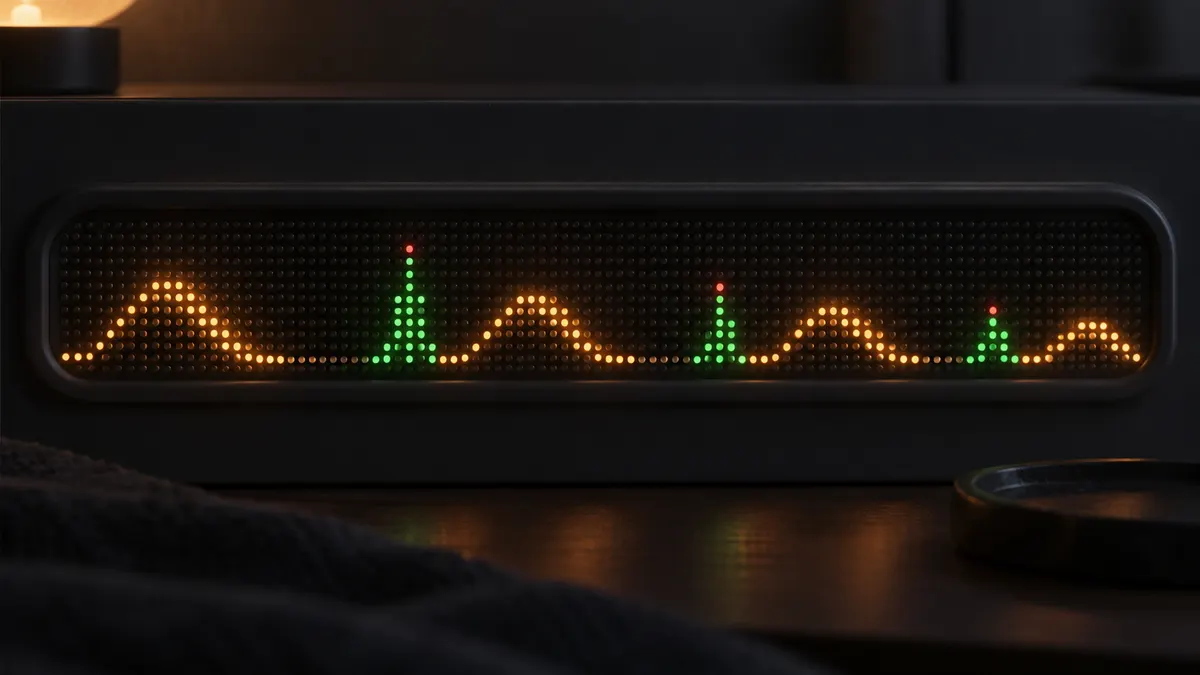
Catathrenia is groaning in your sleep: after a deep breath in, you breathe out slowly through a partly closed throat and make a long, monotone moan, usually 2 to 49 seconds, repeated in clusters. You almost certainly do not know you do it; in a survey of people with catathrenia, 94% learned about it from someone else (Alonso et al. 2017). It is not snoring, which happens on the in-breath, and the main problem it causes is usually for whoever sleeps nearby. One recorded night is the first useful step.
- Each groan follows a deep in-breath and lasts about 2 to 49 seconds; groans come in clusters of 2 to 11 that can go on for minutes (Alonso et al. 2017; Overland et al. 2012).
- Snoring is mostly an in-breath sound; catathrenia happens on the out-breath (AASM Sleep Education).
- Nobody knows how common it is: 0.17% to 0.4% of sleep-clinic patients in two series, and about 4% of adults according to a 2024 review (Alonso 2017; Overland 2012; Martel et al. 2024).
- Several studies found most groaning in REM sleep, 81% of 427 clusters in one series (Drakatos et al. 2017), though a 2024 systematic review found REM and non-REM about equal (Blaszczyk et al. 2024).
- Treatment evidence is small: CPAP stopped the groaning in all 7 patients of one series (Guilleminault et al. 2008), and a mandibular advancement device lowered the groaning index from 5.8 to 2.8 an hour in 30 patients (Yu et al. 2021).
What is catathrenia?
Catathrenia is a sleep-related groaning pattern, first described as a separate condition in 2001 in four young patients whose groaning had started between the ages of 5 and 16 (Vetrugno et al. 2001). It was first filed as a parasomnia, like sleepwalking. The current international classification, ICSD-3, lists it under sleep-related breathing disorders, as an isolated symptom rather than a disease (Yu et al. 2021).
It usually starts in childhood or the teens; across published cases, onset ranges from age 4 to 36 (Alonso 2017). Studies disagree on whether men or women are affected more, and a 2024 systematic review found a similar frequency in both. The complaint almost always comes from whoever sleeps nearby: in the 2017 survey, 62% first heard about it from a bed partner, and in a 2026 survey of 176 adults, 71% said it strained things with a partner or roommate (Wen et al. 2026).
What does catathrenia sound like?
It sounds like a long, sad moan or a drawn-out sigh, often in one steady pitch. The breathing pattern behind it is consistent: a deep breath in, a short pause, a slow and prolonged breath out with the groan, then a quick final exhale, sometimes with a small snort, before normal breathing resumes (Drakatos et al. 2017). The sound comes from the voice box, not from the soft palate that flutters in snoring (Iriarte et al. 2011).
Groans repeat in clusters. One series counted 2 to 11 groans per cluster, with each cluster lasting 11 seconds to nearly 3 minutes (Overland 2012); the AASM describes clusters lasting from two minutes to an hour. If most of it happens in REM sleep, expect more of it in the second half of the night, when REM periods get longer.
Catathrenia vs snoring vs sleep apnea vs sleep talking
| Catathrenia | Snoring | Obstructive sleep apnea | Sleep talking | |
|---|---|---|---|---|
| Sound | Monotone groan or moan | Rattling, fluttering | Snoring, then silence, then a snort or gasp | Words, mumbles, laughter |
| Part of the breath | Out-breath, after a deep in-breath | Mostly in-breath | Silence is breathing that stopped | Any |
| Length | 2 to 49 seconds per groan, in clusters | Minutes at a stretch | Gaps of 10 seconds or more, repeating | Seconds |
| Usual meaning | Mostly a problem for the partner | A narrowed airway | A medical condition that needs a sleep test | Usually harmless |
The tricky one is the overlap with apnea. During the long out-breath with the groan, airflow is low, and on some sleep tests the episodes have been scored automatically as central apneas (Siddiqui et al. 2008; Kazaglis 2018). Some people with catathrenia also have sleep-disordered breathing, which is why one research group asked whether catathrenia is partly a breathing problem (Guilleminault et al. 2008). If the groaning comes with snoring, gasps or daytime sleepiness, a sleep test is worth it. Snoring vs sleep apnea shows what the apnea pattern sounds like.
How to record groaning in your sleep with your phone
Clinicians ask for exactly this. Cleveland Clinic suggests recording yourself sleeping so your provider can listen to the audio, and Sleep Foundation notes that audio recordings can help doctors identify catathrenia.
- Put the phone on the nightstand, 0.5 to 1 m from your head, plugged in, with Do Not Disturb on and no fan pointed at it.
- Record the whole night. Groans are long and quiet compared with snoring, and an app that saves only snoring may not keep them. Voice Memos records everything for free; Snorly Premium's full-night audio does the same.
- In the morning, look for the pattern: a deep breath in, a long moan on the breath out, a quick exhale, repeated several times in a few minutes.
- Note the time of each cluster and the position you woke up in. In one study groaning was more frequent on the back than on the side (Takei et al. 2025).
Snorly has no groaning label. It saves clips when it hears snoring, talking or coughing; a groan may land in one of those or be missed, so use full-night audio for this question. How to record yourself snoring has more on placement and file sizes.
How is catathrenia treated?
Often it is not treated, because the main problem is the noise for others. Treatment is for when the partner cannot sleep, or when a sleep test also finds a breathing problem. The usual route is a sleep study with audio and video, which is how catathrenia is told apart from snoring, apnea and sleep talking.
The evidence comes from small series:
| Treatment | Result | Study |
|---|---|---|
| CPAP | Groaning stopped in all 7 patients | Guilleminault 2008 |
| CPAP, long term | Helped, but only 3 of 9 still used it after 12 months | Drakatos 2017 |
| Mandibular advancement device | Groaning index from 5.8 to 2.8 an hour in 30 patients | Yu 2021 |
| Mandibular advancement device | Worked for 3 of 6 patients | Drakatos 2017 |
| Upper-airway surgery | Groaning resolved in the 4 patients followed up, 3 with an oral appliance added | Guilleminault 2008; a later review doubts its value (Alonso 2017) |
If no breathing problem shows up, the practical fixes are for the bed partner: earplugs, white noise, or separate rooms without the drama. How to sleep when your partner snores covers those, and they work the same for groaning.
Why do I moan in my sleep if it is not catathrenia?
Not every moan is catathrenia. Sleep talking often includes moans, mumbles and laughter, mixed with words; sleep talking explains what those recordings usually contain. A single groan when you roll over, or a sigh, is ordinary. Catathrenia is a repeated pattern: the same monotone groan, on the breath out, many times in a cluster.
- Put the phone on the nightstand, 0.5 to 1 m from your head, plugged in, and record the whole night.
- Ask your partner to note roughly when the groaning woke them, so you know where to listen.
- In the morning, find one cluster and listen for the deep breath in, then the long moan on the breath out.
- If you also hear snoring with silent gaps and gasps, or you feel sleepy in the daytime, take the recording to a doctor.
Hear your own snoring tonightSnorly records only when it hears snoring and plays it back in the morning. Free, no account, no night limit.
Download on the App StoreRelated questions
Is catathrenia a sleep disorder?
It is classified as one. ICSD-3 lists it under sleep-related breathing disorders as an isolated symptom. Its main effect is usually on the person listening.
Is catathrenia related to sleep apnea?
Sometimes. They are different patterns, but some people have both, and catathrenia can look like central apnea on a sleep test. Groaning with snoring, gasps or daytime sleepiness is a reason for a sleep study.
Why do I groan when I breathe out in my sleep?
That is the definition of catathrenia: a deep in-breath, then a slow out-breath through a narrowed voice box that makes a groan. Why some people do it is not known.
Can a snoring app detect catathrenia?
Not reliably. Snoring apps are built to find snoring, which sounds different and happens on the in-breath. Record the whole night and listen for the pattern yourself, then let a sleep clinic confirm it.
Can catathrenia be treated?
Yes, when it needs to be. CPAP and mandibular advancement devices have helped in small studies. Many people choose no treatment once a sleep test rules out a breathing problem.
Sources
- Vetrugno R, Provini F, Plazzi G, et al. (2001). Catathrenia (nocturnal groaning): a new type of parasomnia. Neurology 56(5):681-683. https://pubmed.ncbi.nlm.nih.gov/11245728/
- Alonso J, Camacho M, Chhetri DK, et al. (2017). Catathrenia (Nocturnal Groaning): A Social Media Survey and State-of-the-Art Review. Journal of Clinical Sleep Medicine 13(4):613-622. https://pmc.ncbi.nlm.nih.gov/articles/PMC5359339/
- Drakatos P, Higgins S, Duncan I, et al. (2017). Catathrenia, a REM predominant disorder of arousal? Sleep Medicine 32:222-226. https://pmc.ncbi.nlm.nih.gov/articles/PMC6554196/
- Overland B, Akre H, Berdal H, et al. (2012). Sleep-related groaning: prevalence and characteristics in a cohort of patients with suspected obstructive sleep apnea. Acta Oto-Laryngologica 132(1):90-95. https://pubmed.ncbi.nlm.nih.gov/22074488/
- Guilleminault C, Hagen CC, Khaja AM (2008). Catathrenia: parasomnia or uncommon feature of sleep disordered breathing? Sleep 31(1):132-139. https://pubmed.ncbi.nlm.nih.gov/18220087/
- Yu M, Hao Z, Xu L, et al. (2021). Mandibular advancement device as treatment trial for catathrenia (nocturnal groaning). Journal of Clinical Sleep Medicine 17(9):1767-1776. https://pmc.ncbi.nlm.nih.gov/articles/PMC8636353/
- Blaszczyk B, Wichniak A, Wieckiewicz M, et al. (2024). The clinical characteristic of catathrenia: a new look at an old issue-a systematic review of existing literature. Sleep and Breathing 28(4):1523-1537. https://pmc.ncbi.nlm.nih.gov/articles/PMC11303500/
- Martel Q, Maranci JB, Philippe C, et al. (2024). Lamentations in the night: A systematic review on catathrenia. Sleep Medicine Reviews 75:101944. https://pubmed.ncbi.nlm.nih.gov/38718707/
- Iriarte J, Fernández S, Fernandez-Arrechea N, et al. (2011). Sound analysis of catathrenia: a vocal expiratory sound. Sleep and Breathing 15(2):229-235. https://pubmed.ncbi.nlm.nih.gov/20886300/
- Siddiqui F, Walters AS, Chokroverty S (2008). Catathrenia: a rare parasomnia which may mimic central sleep apnea on polysomnogram. Sleep Medicine 9(4):460-461. https://pubmed.ncbi.nlm.nih.gov/18086548/
- Kazaglis L (2018). The Value of a Well-Trained Ear: Incidental Detection of Catathrenia on Home Sleep Apnea Tests in Patients With Low Probability for Obstructive Sleep Apnea. Journal of Clinical Sleep Medicine 14(12):2083-2086. https://pmc.ncbi.nlm.nih.gov/articles/PMC6287729/
- Wen Y, Xu L, Wu S, et al. (2026). Clinical characteristics and associated factors of self-reported catathrenia: A web-based survey of 176 Chinese adults. Sleep and Breathing 30. https://pubmed.ncbi.nlm.nih.gov/42726153/
- Takei Y, Nakayama H, Inoue Y (2025). Characteristics of clinical descriptive variables and polysomnographic findings of catathrenia. Journal of Clinical Sleep Medicine 21(2):377-381. https://pmc.ncbi.nlm.nih.gov/articles/PMC11789240/
- American Academy of Sleep Medicine, Sleep Education (accessed 2026). Groaning. https://sleepeducation.org/sleep-disorders/groaning/
- Cleveland Clinic (accessed 2026). Catathrenia. https://my.clevelandclinic.org/health/diseases/catathrenia
- Sleep Foundation (accessed 2026). Catathrenia. https://www.sleepfoundation.org/sleep-related-breathing-disorders/catathrenia
Snorly is a snore recorder and tracker, not a medical device. It does not diagnose sleep apnea or any other condition. If you notice pauses in breathing, gasping or daytime sleepiness, talk to a doctor.